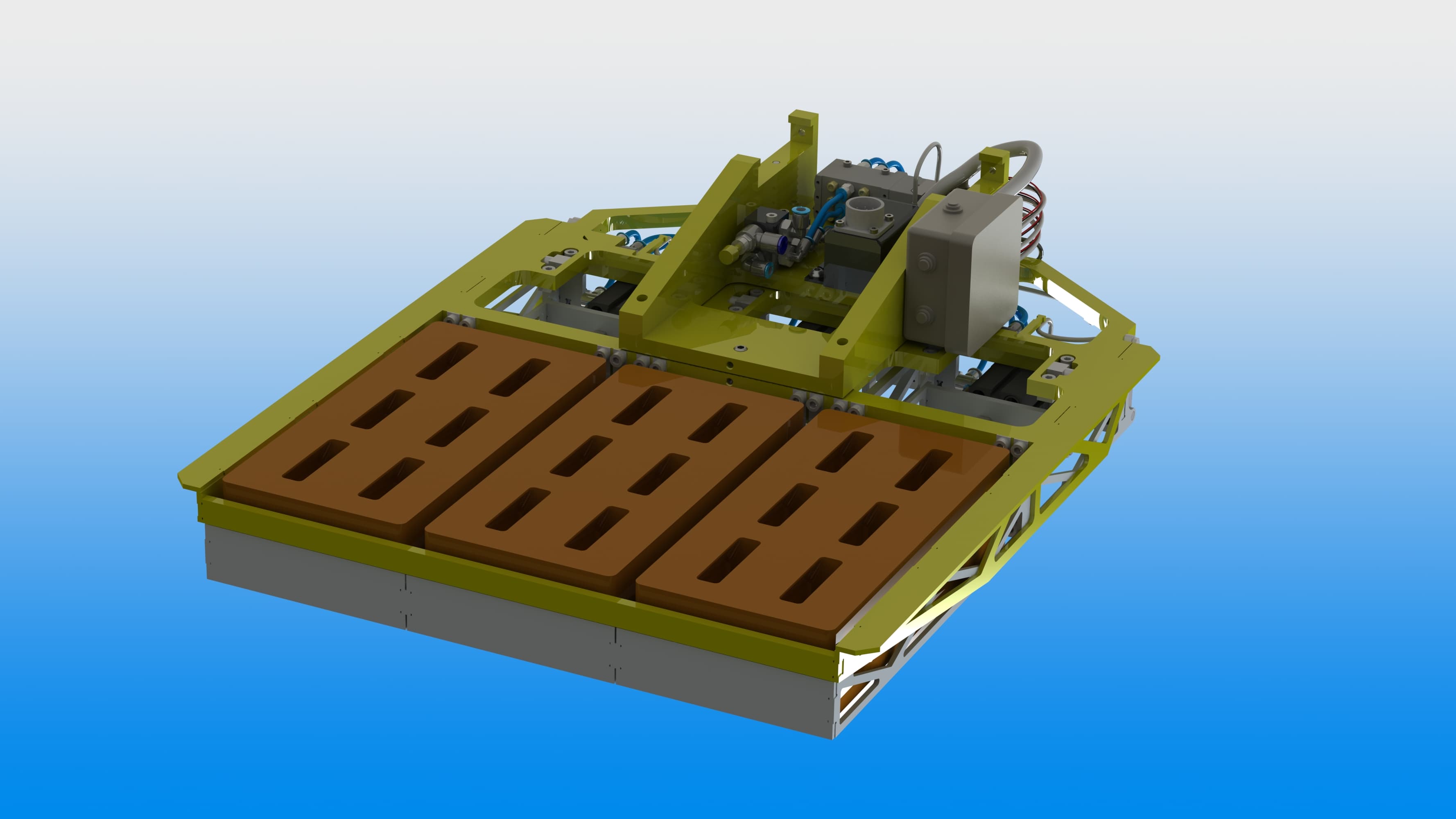
Robotic end-effector · Magnetic mount · Standard line
Standard Gripper — Magnetic-Mount End-Effector for Press Exits
Client
Confidential — Building Materials
Duration
8 weeks
Year
2018
A standard end-effector for robotic manipulators on construction-material lines: removes pressed product from semi-dry pressing equipment and arranges it per a preset stacking program. 1 to 9 products per cycle, 15 kg load capacity, magnetic attachment system for clean integration with the manipulator.
Engagement Metrics
1 – 9
Products per cycle
15 kg
Load capacity
Magnetic system
Attachment
Standard press exit
Application
From the project
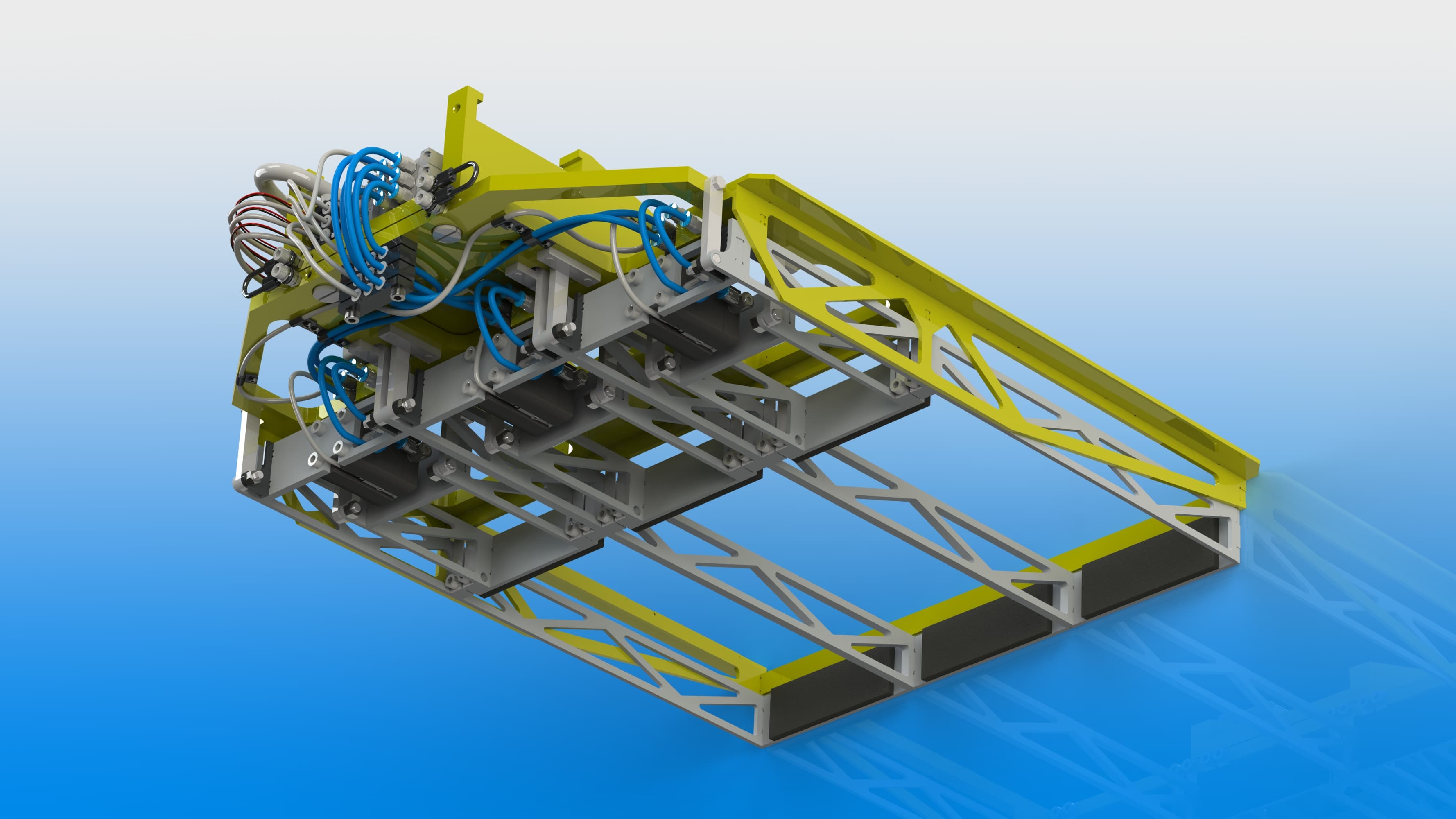
2 imagesAttached — magnetic mount, 15 kg load envelope. Detail — multi-product cycle gripping geometry.
The Challenge
The standard product line — facing brick on semi-dry pressing — needs a default gripper that runs out of the box on conventional robotic manipulators. Not a KUKA-specific design, not a corner-element design, not a tile-rotating design. Just the workhorse end-effector that handles the bulk of the line's daily output.
What "standard" means in practice
- *Magnetic attachment.* The gripper attaches to the manipulator magnetically — fast swap when a different end-effector is needed for a different product.
- *Standard product handling.* Facing brick at the press's typical output count per cycle.
- *15 kg load envelope.* Sized to standard cladding-product weight at the press's typical output.
- *Programmable stacking.* Per-product stacking patterns set at the cell controller, executed by the manipulator + gripper.
Why the magnetic mount matters
A line that produces multiple product types (standard brick, corner elements, tiles) benefits from end-effector swapping at the manipulator rather than physical re-tooling. Magnetic mount means a 30-second swap to the right end-effector for the next product run, rather than a fastener-by-fastener change.
Our Approach
We designed the gripper as the standard workhorse: handles 1 to 9 products per cycle at 15 kg total, mounts via a magnetic attachment system, and follows a preset stacking program executed by the cell controller.
Engineering inputs
- *Magnetic attachment system.* Designed to engage and release on command — clean swap without operator intervention at the mount.
- *Output count flexibility.* Same gripper handles single-product and multi-product cycles within the 1-to-9 range.
- *Standard cladding geometry.* Gripper geometry tuned to the line's most common cladding product family.
- *Cell-controller programmable.* Stacking patterns set by program at the controller; the gripper follows.
Why this is the "default" gripper
For lines that produce primarily standard cladding products with occasional product variants, the right architecture is a default gripper that handles ≥80% of cycles, plus a small set of specialty grippers (corner, tile rotation, large-format) that swap in via the magnetic mount when needed. This is the default.
Results
The gripper runs as the standard end-effector on construction-material lines, handling cladding output at 1 to 9 products per cycle and 15 kg load capacity. Magnetic mount permits rapid swap to specialty grippers for product variants.
Production behavior
- *Default cycle.* Handles the bulk of cladding output on the line.
- *Swap to specialty.* When the run shifts to corner elements or tiles, swap to the corresponding specialty gripper via the magnetic mount.
- *Predictable mass.* 15 kg load — easy to budget at robot specification.
Gripper family architecture
This gripper is the default in a small family of end-effectors that share the same magnetic mount:
- *Standard* (this gripper) — cladding output, 1-9 products/cycle.
- *Pneumatic-cushion corner* — corner-element handling.
- *Rotary tile* — facing tile with 90° rotation for stacking.
- *KUKA-adapted* — direct-mount variant for KUKA-specific cells.
A line runs the standard gripper as default and swaps to the specialty grippers when production calls for them. Same line, same magnetic mount, different end-effectors per product.
Browse the portfolio
Filter by industry or service.
Next case studyPneumatic-Cushion Gripper — Corner-Element End-Effector
Industrial & Manufacturing
Related Engagements
- Industrial & Manufacturing
Press Molds for Semi-Dry Pressing — Facing-Product Family at 300 kg/cm²
Read - Industrial & Manufacturing
Heat & Humidity Curing Chamber — 8-Hour Strength Cycle with Heat Recovery
Read - Industrial & Manufacturing
Mechanical Engineering Workshop — 600 m² Tooling Production Build-Out
Read