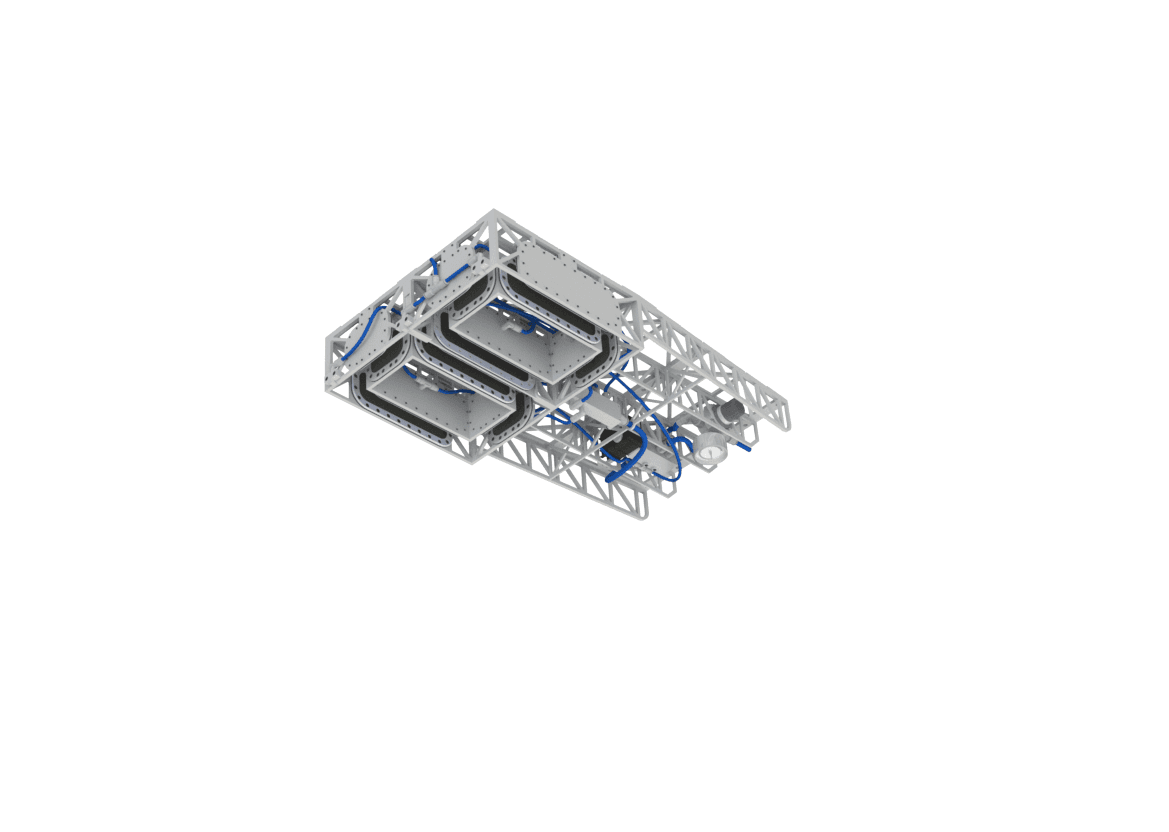
Robotic end-effector · Corner elements · Pneumatic cushion
Pneumatic-Cushion Gripper — Corner-Element End-Effector
Client
Confidential — Building Materials
Duration
6 weeks
Year
2019
A pneumatic-cushion gripper specifically designed for handling corner elements on a semi-dry-pressing cladding line. Removes corner products from the press and arranges them per a preset stacking program. 15 kg load capacity.
Engagement Metrics
15 kg
Load capacity
Corner elements
Specialization
Pneumatic cushion
Grip principle
Press exit → stacking
Function
From the project
1 imagePneumatic-cushion contact — conformable, non-marking, edge-safe.
The Challenge
Corner elements are geometrically different from standard facing brick — and they're tolerance-critical because they interface with both wall and corner in ventilated façade installations. A standard flat-grip gripper that works fine on standard brick risks marking, edge-chipping, or angled-surface mis-gripping on corner products.
What corner elements demand from the gripper
- *Conformable contact.* Corner geometry varies along the edge — rigid gripping surfaces don't conform; pneumatic cushions do.
- *Edge protection.* Corner products are visible on installation. Edge chipping or surface scuffing from the gripper is a defect that propagates into the façade.
- *Stacking-pattern compatibility.* Corner products stack into their own cage patterns; the gripper has to follow corner-specific preset programs.
Why a separate gripper rather than a universal one
A universal gripper that handles both standard brick and corner elements would compromise on both. The line architecture instead is: standard gripper as default, swap to specialty grippers (this one, plus rotary for tiles) when the run shifts. Magnetic mount makes the swap fast.
Our Approach
We designed a gripper using pneumatic cushions as the contact surface — conformable, non-marking, sized to the cladding-line robot's standard 15 kg load capacity and standard magnetic mount.
Engineering inputs
- *Pneumatic cushion contact.* Conformable contact surfaces that grip corner geometry without rigid contact loads on visible faces.
- *15 kg load envelope.* Matches the standard line gripper family — interchangeable on the same robot via the magnetic mount.
- *Corner stacking program.* Cell controller runs corner-specific preset patterns; the gripper executes.
- *Edge protection.* Cushion geometry tuned to keep contact off the visible edges that interface with façade installation.
Why pneumatic, not vacuum or mechanical
Vacuum cups need a flat sealing surface — corner geometry doesn't reliably provide one. Mechanical jaws need rigid contact — corner edges chip. Pneumatic cushions conform to the local geometry and distribute contact load — the right physics for this product class.
Results
The pneumatic-cushion gripper handles corner products at 15 kg load capacity, swappable onto any standard cladding-line robot via the magnetic mount. Corner elements arrive at the cage with cladding-spec surface finish preserved.
Production behavior
- *Surface preservation.* Visible edges arrive at the cage without contact damage.
- *Stacking-program follower.* Corner-specific cage patterns executed without operator intervention.
- *Family interchange.* Same magnetic mount as the standard gripper — swap as the production run shifts product type.
Specialty gripper economics
Specialty grippers cost more per unit than universal designs. The economic answer is family architecture: one default gripper (the standard), plus a small set of specialty grippers (pneumatic-cushion corner, rotary tile, large-format) that share a magnetic mount and swap in only when needed.
For a line that runs corner elements as 10-20% of its production, the right answer is this dedicated gripper plus the standard for the rest. The corner-quality outcome is meaningfully better than a universal gripper would deliver — and the swap cost is 30 seconds at the mount.
Browse the portfolio
Filter by industry or service.
Next case studyRotary Gripper — 90° Rotation for Facing-Tile Stacking
Industrial & Manufacturing
Related Engagements
- Industrial & Manufacturing
Press Molds for Semi-Dry Pressing — Facing-Product Family at 300 kg/cm²
Read - Industrial & Manufacturing
Heat & Humidity Curing Chamber — 8-Hour Strength Cycle with Heat Recovery
Read - Industrial & Manufacturing
Mechanical Engineering Workshop — 600 m² Tooling Production Build-Out
Read