Process equipment · Cement-bound curing · Heat recovery
Heat & Humidity Curing Chamber — 8-Hour Strength Cycle with Heat Recovery
Client
Confidential — Building Materials
Duration
18 weeks
Year
2020
A fully automated heat-and-humidity curing chamber for cement-bonded hyperpressed bricks. Designed to bring product strength to near-complete cure within an 8-hour cycle, with a heat recovery zone that materially reduces energy demand per cycle.
Engagement Metrics
8 hours
Cycle to near-complete strength
Heat + humidity
Cycle medium
Recovery zone
Energy strategy
Cement-bound hyperpressed
Process type
From the project
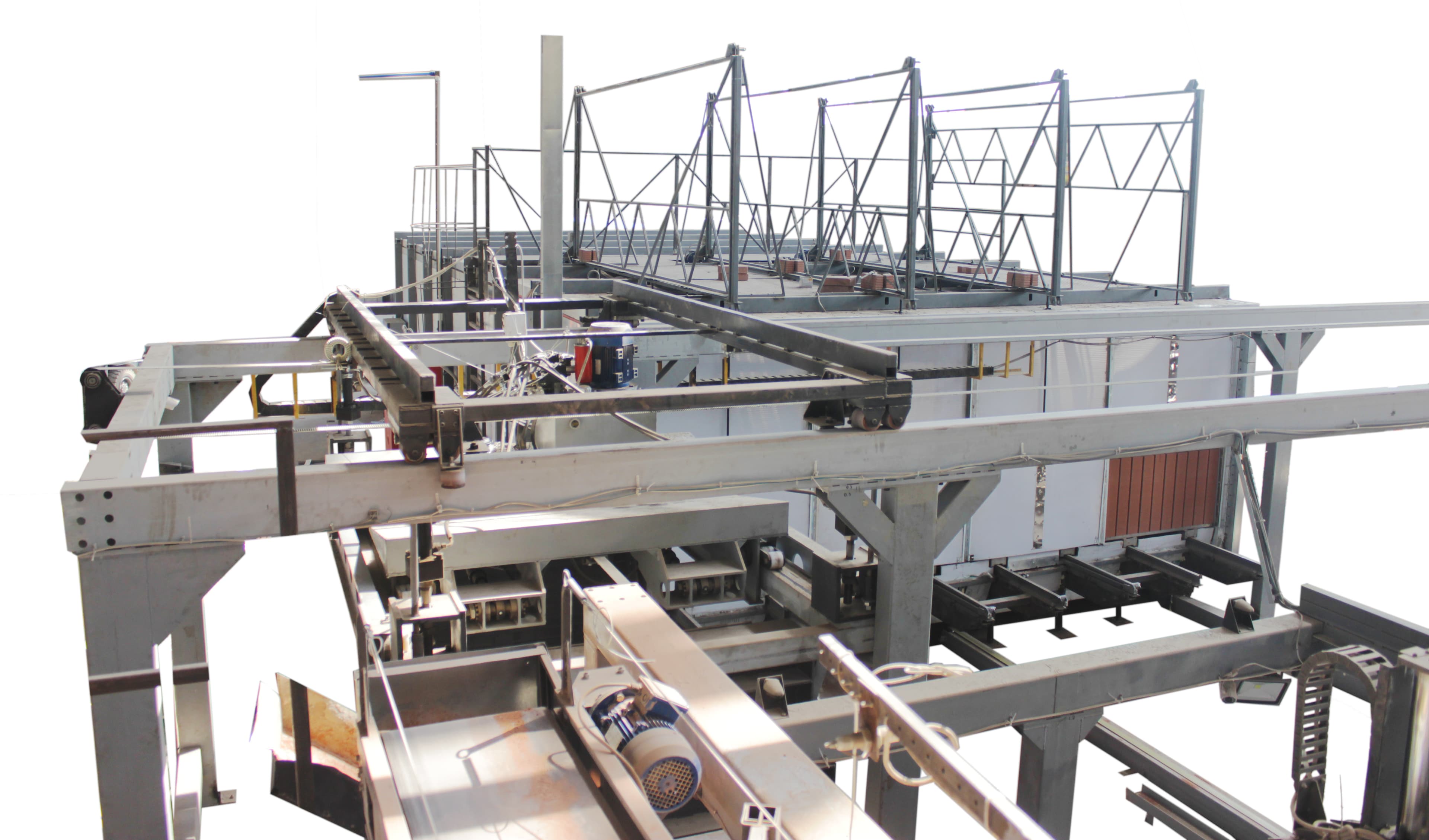
1 imageDesign render — automated heat-and-humidity curing volume with integrated heat recovery.
The Challenge
Cement-bound hyperpressed brick reaches near-complete strength on a curing cycle measured in hours, not days. The variable that compresses the cycle is the curing medium — controlled heat and humidity instead of ambient air. Pulling that cycle down to 8 hours requires precise medium control; doing it without ballooning the plant's energy bill requires the chamber to recover heat between cycles instead of dumping it.
What an 8-hour cycle has to deliver
- *Near-complete strength.* The product leaves the chamber ready for stacking, palletization, and shipment — not pending a second cure step.
- *Uniform cure across the chamber volume.* Bricks in the middle of the stack have to cure on the same envelope as bricks on the perimeter.
- *Repeatable medium profile.* Heat-up, dwell, and cool-down ramps have to be the same on cycle 1 and cycle 1000.
Why heat recovery is the hidden engineering item
The chamber heats up, holds, and cools down per cycle. Without recovery, every cycle's heat input is lost to ambient at the end. With a recovery zone, a meaningful fraction of that heat is captured to pre-warm the next charge — which is the difference between a chamber that hits its strength spec and a chamber that hits its strength spec *at acceptable cost per brick*.
Our Approach
We designed the chamber as a fully automated curing volume with explicit heat-and-humidity control through the full cycle, and a heat recovery zone integrated into the cycle architecture rather than added as an afterthought.
Cycle architecture
- *Loading.* Automated charging — the chamber accepts a pre-stacked load without operator intervention per cycle.
- *Heat-up ramp.* Controlled medium ramp to the curing dwell temperature, with humidity tracking heat to keep the curing envelope inside spec.
- *Dwell.* Heat-and-humidity hold for the bulk of the 8-hour cycle.
- *Cool-down + recovery.* Outgoing medium heat is captured into the recovery zone rather than vented — the next charge pre-warms on that recovered heat.
- *Unloading.* Automated discharge to downstream palletization.
Engineering choices that compress the cycle
- *Humidity, not just heat.* Cement-bound hyperpressed brick cures faster under controlled humidity — humidity is a load-bearing variable, not a comfort setting.
- *Volume-uniform medium delivery.* The chamber's internal flow geometry keeps the curing medium homogeneous across the load.
- *Closed-loop sensing.* Heat and humidity sensors feed control, not just monitoring. Drift gets corrected in-cycle.
- *Recovery zone integrated to cycle.* The recovery is part of the cycle, not a bolt-on — so the energy savings compound with every cycle the plant runs.
Results
The chamber design delivers near-complete strength on cement-bonded hyperpressed brick within an 8-hour cycle, with the heat recovery zone meaningfully reducing per-cycle energy demand compared to vent-and-dump alternatives.
What this means downstream
- *Same-day shipment.* An 8-hour cure means the brick can move from press → curing chamber → palletization → dispatch within a working day.
- *Energy economics.* Recovery zone shifts the per-brick energy line item enough to move plant economics, not just round error.
- *Fully automated.* No per-cycle operator intervention — the chamber runs as a stage in a larger automated line.
Where this chamber sits in a brick line
The chamber is the stage that converts a freshly-pressed green body into a shippable cured brick. On an integrated brick line — for example, the kind we designed for the 15M-bricks/year facing-brick program — the chamber takes the press output, runs the 8-hour cycle, and hands cured product to palletization without operator intervention between stages.
The heat recovery zone is the engineering decision that makes the line viable at industrial-site footprints. Without it, the chamber's cycle energy demand would force either a larger plant footprint or a per-brick cost that doesn't compete with traditional brick production economics.