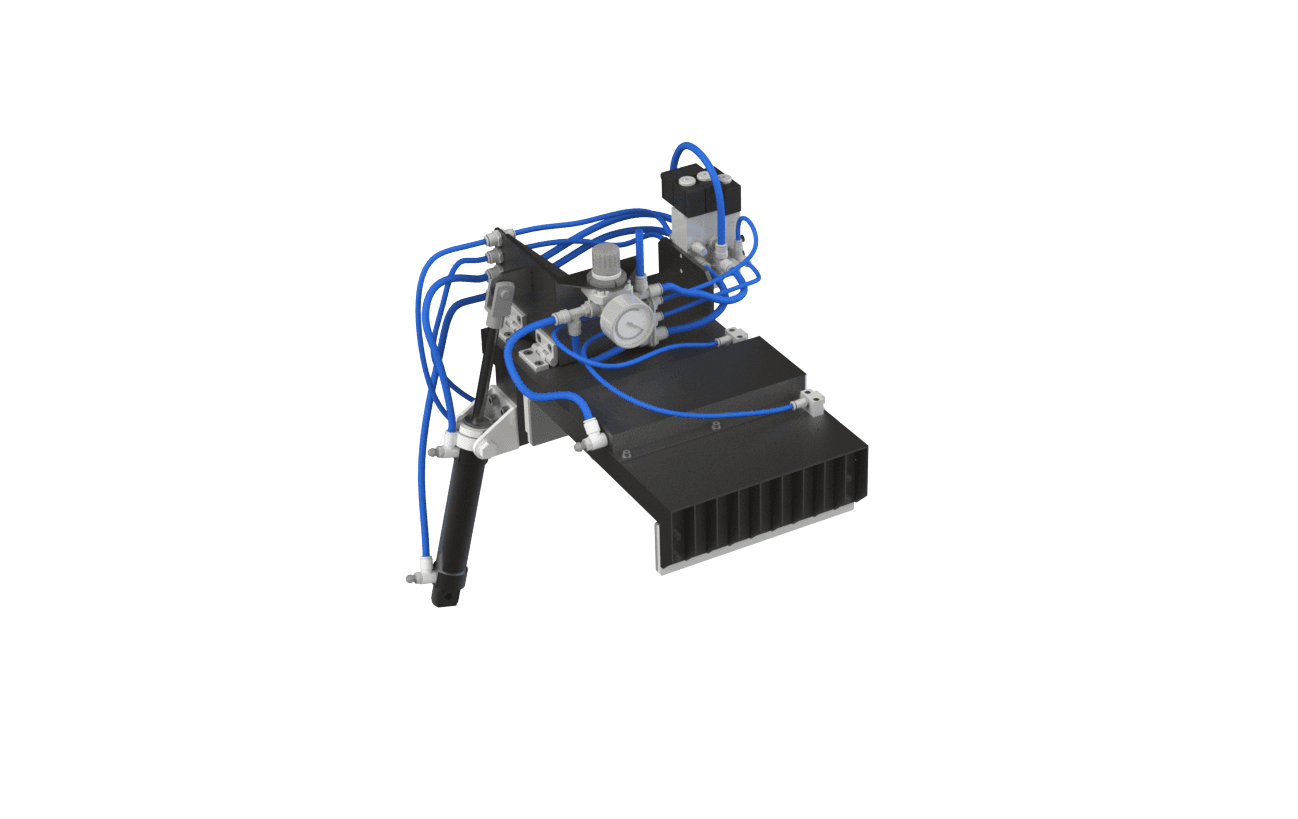
Robotic end-effector · 90° rotation · Facing tile
Rotary Gripper — 90° Rotation for Facing-Tile Stacking
Client
Confidential — Building Materials
Duration
6 weeks
Year
2019
A rotary gripper for handling and stacking facing tiles, with a built-in 90° rotation function that lets the manipulator place tiles one on top of another in alternating orientation after removal from the press. 15 kg load capacity, magnetic mount.
Engagement Metrics
15 kg
Load capacity
90° in-gripper
Rotation
Facing tile stacking
Specialization
Press exit → cage
Function
From the project
1 imageRotary gripper — 90° in-gripper rotation for alternating-tile stacking.
The Challenge
Facing tiles stack tightest when alternating tiles are rotated 90° to each other — same footprint, denser stack, more product per pallet. The press, however, outputs tiles in a single fixed orientation. Without rotation between press exit and cage, every tile lands at the same orientation and the stack density suffers.
Two options the line had
- *Rotate the cage.* Index the receiving cage between every other tile. Mechanically heavy; cage-side complication; cycle time penalty.
- *Rotate the tile.* Add 90° rotation between gripping and placement. Mechanically local to the gripper; no cage-side change; cycle time absorbed inside the manipulator's existing motion.
We took option 2. The gripper does the rotation; the cage doesn't have to know.
Why rotation matters at this product class
Facing tiles are a high-volume cladding product. Stack density compounds at every level of palletization, transport, and storage. A 10-15% density improvement at the cage level becomes a 10-15% throughput improvement across every downstream stage.
Our Approach
We designed a rotary gripper with a 90° rotation function integrated into the end-effector — the manipulator picks the tile in the press's natural orientation, rotates 90° in-gripper, and places into the cage in the alternating orientation. 15 kg load, magnetic mount, family-compatible.
Engineering inputs
- *90° rotation function.* Built into the gripper, not implemented as cell-controller motion — keeps the cycle simple.
- *15 kg load envelope.* Matches the standard-gripper family.
- *Magnetic mount.* Swappable with the standard gripper on the same robot.
- *Stacking-program follower.* Cell controller specifies whether each cycle rotates; the gripper executes.
Why in-gripper rotation, not robot-side
The manipulator's wrist could rotate the tile — but doing so consumes cycle time and adds wrist load. In-gripper rotation happens in parallel with the manipulator's transport motion, so the alternation is free in cycle terms.
Results
The rotary gripper handles facing-tile output, executing 90° rotation on alternating tiles for denser stacking. 15 kg load envelope; magnetic mount keeps it interchangeable with the standard gripper on the same robot.
Production behavior
- *Denser stacks.* Alternating-orientation stacks improve pallet density vs same-orientation stacks.
- *Same robot, no wrist load.* The gripper does the rotation; the manipulator's motion envelope is unchanged.
- *Run-time alternation.* Cell controller chooses per-cycle whether to rotate — supports mixed-pattern stacking when needed.
Where this matters in the line
Stack density compounds. Better density at the cage means better density on the pallet means better density on the truck means more product to the customer per logistics cycle. A 90° rotation that costs zero cycle time and adds zero wrist load is engineering that pays back across every downstream stage of the line — not just at the press exit.
Browse the portfolio
Filter by industry or service.
Next case studyBelt Ore Dispenser — 70 t/h with 30-Minute Belt Swap
Industrial & Manufacturing
Related Engagements
- Industrial & Manufacturing
Press Molds for Semi-Dry Pressing — Facing-Product Family at 300 kg/cm²
Read - Industrial & Manufacturing
Heat & Humidity Curing Chamber — 8-Hour Strength Cycle with Heat Recovery
Read - Industrial & Manufacturing
Mechanical Engineering Workshop — 600 m² Tooling Production Build-Out
Read