Bulk handling · Dosing · Mining feedstock
Belt Ore Dispenser — 70 t/h with 30-Minute Belt Swap
Client
Confidential — Mining & Materials
Duration
10 weeks
Year
2018
A belt-type ore dispenser with smooth productivity adjustment up to 70 tons per hour. Designed for fast maintenance: the conveyor belt can be replaced within half an hour, keeping plant downtime measured in minutes, not shifts.
Engagement Metrics
70 t/h
Max productivity
≤ 30 minutes
Belt swap time
Smooth, continuous
Adjustment
Ore dosing → mixer
Function
From the project
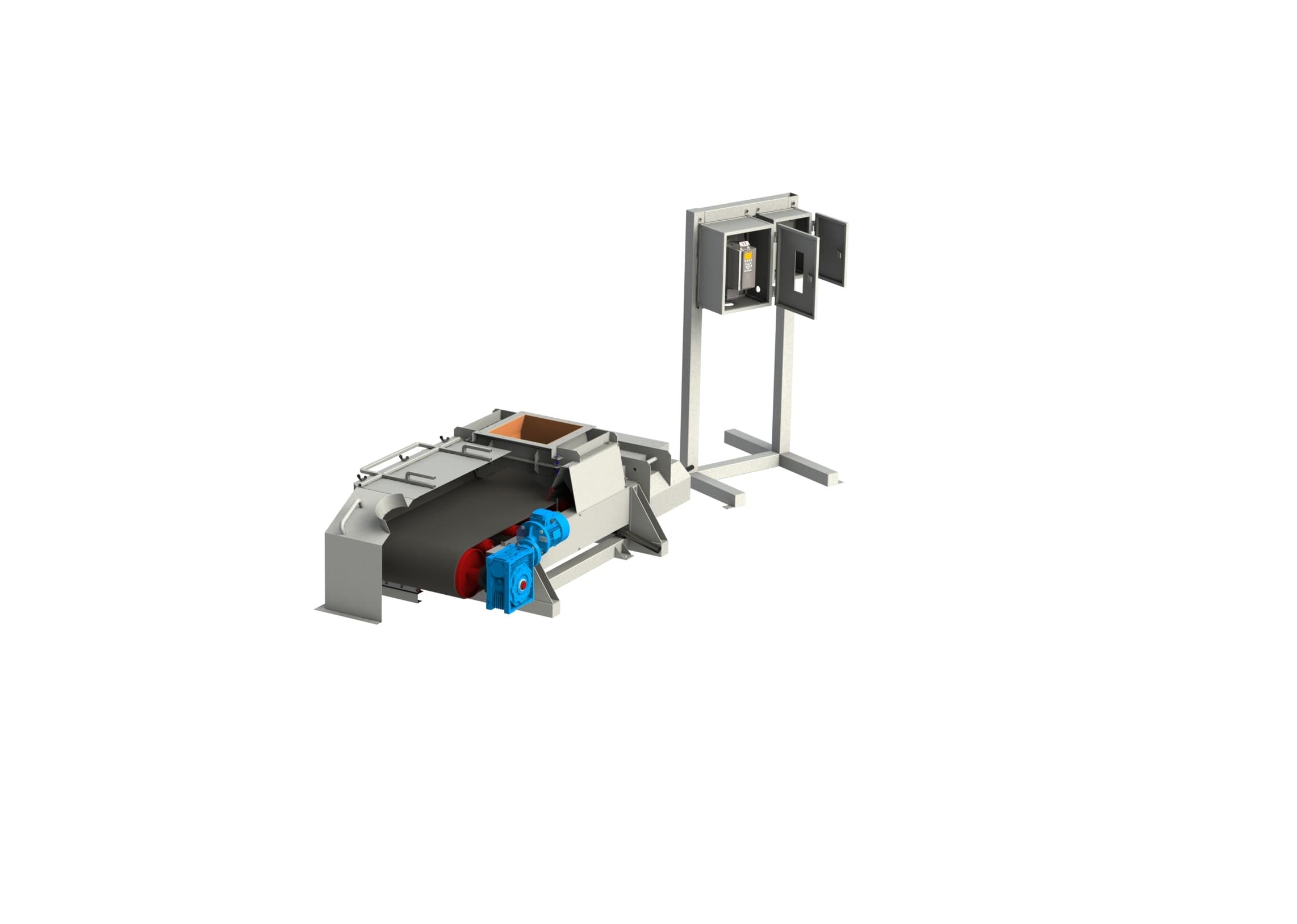
1 imageFull assembly — variable drive, operator-swap belt, plant-grade frame.
The Challenge
An ore dispenser feeds downstream stages — mixers, crushers, processing lines — at a controlled rate. Two failure modes dominate: dosing inaccuracy (downstream stage receives the wrong feed rate) and belt-wear downtime (the belt is a wear item, and conventional dispensers can take a half-shift to swap).
What the brief demanded
- *Continuous adjustment.* Productivity continuously variable up to 70 t/h — not stepped, not catalog-discrete.
- *Fast maintenance.* The conveyor belt is the wear item; swap has to fit inside a plant break, not require a planned outage.
- *Service-life economics.* The dispenser is part of a longer line. Downtime on the dispenser is downtime on every downstream stage.
Why 30 minutes matters
A belt swap that takes 30 minutes can be slotted into a normal shift break or a planned cleaning cycle. A belt swap that takes 3 hours is a planned outage that has to be scheduled — and the whole line waits.
Our Approach
We engineered the dispenser around two specifications: smooth productivity adjustment via drive control, and a belt-mounting architecture that lets the operator do the swap in 30 minutes flat.
Smooth productivity adjustment
- *Drive control.* Variable-speed drive on the conveyor — productivity tracks drive speed across the full 0-to-70 t/h range.
- *Calibrated dosing.* Drive speed → feed rate calibrated for the operator's panel.
- *Stable at the operating point.* No oscillation when held at a setpoint.
30-minute belt swap architecture
- *Frame architecture.* Belt-side access without disassembling adjacent equipment.
- *Mounting hardware.* Standard, operator-friendly fasteners — no specialty tools required for a routine swap.
- *Tensioning system.* Re-tensioning after swap is operator-driven, not engineering-driven.
- *Spare-belt logistics.* The belt is the same spare part the plant already stocks — no specialty pre-order.
Results
The dispenser feeds at up to 70 t/h with smooth continuous adjustment across the full range. Belt swap is operator-executable within a 30-minute window, fitting into standard plant break cycles rather than scheduled outages.
Plant-level impact
- *Predictable downstream feed.* Continuous-adjustment dispensing keeps the downstream stage on its operating point.
- *Minutes, not shifts.* Belt swap on a routine schedule keeps the line running.
- *Wear management.* The belt is consumable; the rest of the dispenser is not.
- *Operator-grade maintenance.* Doesn't require an engineer on-site for a routine belt swap.
Why fast-maintenance design is structural
Fast maintenance isn't a feature added late — it's an architectural choice. The dispenser's frame, fastener pattern, belt path, and tensioning system all had to be designed *together* against the 30-minute target. Designing for production output first and then patching in maintenance access produces equipment that delivers throughput but burns it back in unplanned downtime.
The 30-minute belt swap on this dispenser is what makes the 70 t/h rating *actually achievable* across a service year — not just on a spec sheet.
Browse the portfolio
Filter by industry or service.
Next case studyPigment Dispenser — Granular & Powder Pigment Dosing at the Mixer
Industrial & Manufacturing
Related Engagements
- Industrial & Manufacturing
Press Molds for Semi-Dry Pressing — Facing-Product Family at 300 kg/cm²
Read - Industrial & Manufacturing
Heat & Humidity Curing Chamber — 8-Hour Strength Cycle with Heat Recovery
Read - Industrial & Manufacturing
Mechanical Engineering Workshop — 600 m² Tooling Production Build-Out
Read