Process equipment · Dosing · Cement-based cladding
Pigment Dispenser — Granular & Powder Pigment Dosing at the Mixer
Client
Confidential — Building Materials
Duration
8 weeks
Year
2020
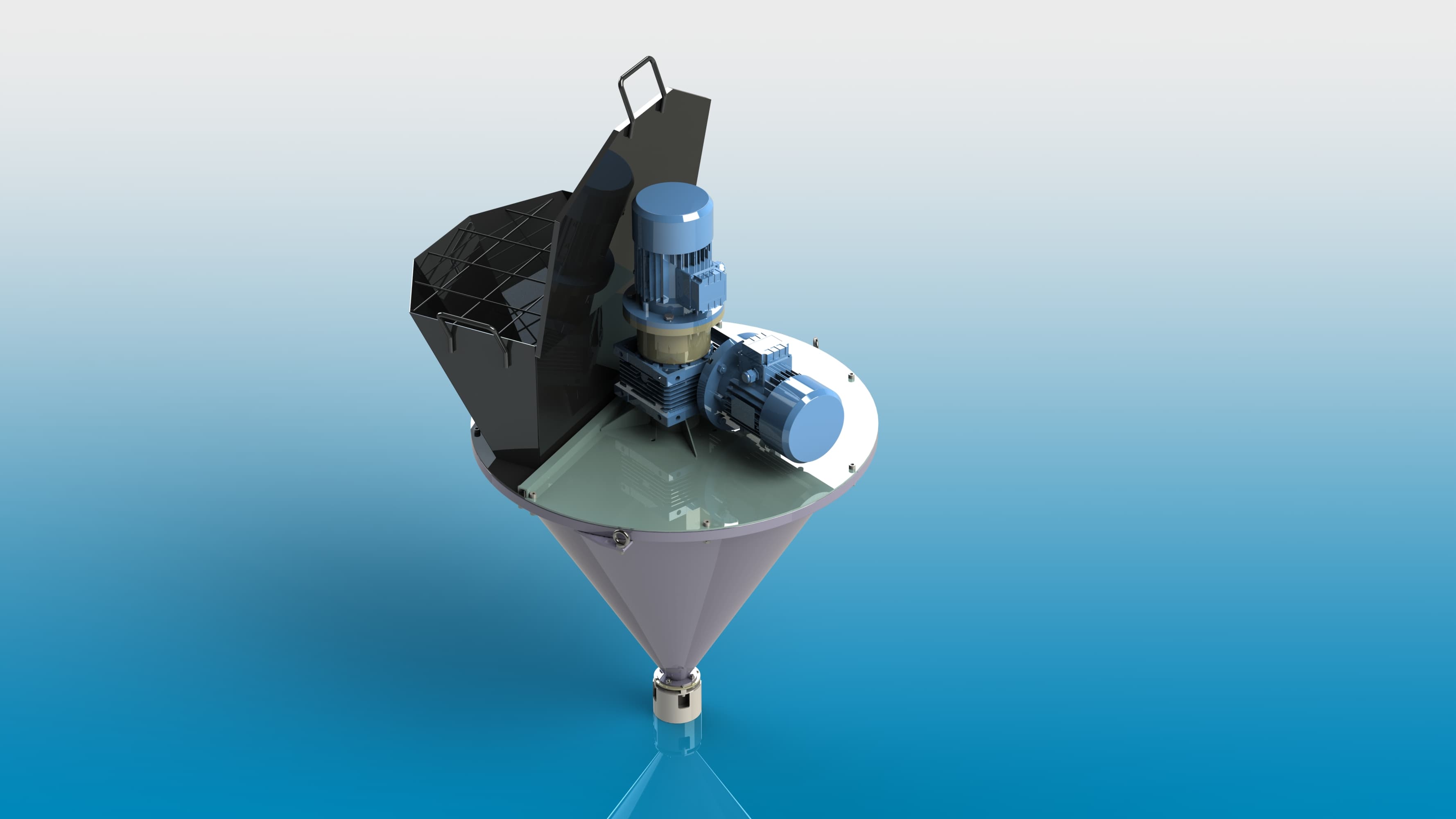
A pigment dispenser for building-cladding production lines, mounted on the conveyor in front of the mixer or directly on the mixer itself. Stores and doses pigment per recipe. Standard model handles granular pigment; an optional weighing nozzle extends accurate dosing to ordinary (non-granular) powder pigment.
Engagement Metrics
Conveyor or mixer
Mounting
Granular + powder
Pigment forms
Weighing nozzle
Accuracy option
Recipe-controlled dosing
Function
From the project
1 imageMounted variant — base unit + optional weighing nozzle for powder pigment.
The Challenge
Building cladding colour comes from pigment dosed into the cement-bound mix. Two engineering questions decide whether the colour is repeatable across a production run: where the pigment enters the process, and how accurately each charge is measured.
Where the pigment enters
Pigment can be added before the mixer (on the conveyor feed) or directly into the mixer. Different lines prefer different points. A dispenser that's tied to one mounting position locks the customer into a single integration pattern. The brief was: support both.
How accurate the charge is
Granular pigment is easy to dose — it flows reliably and weighs predictably. Ordinary powder pigment is harder: it can compact in the hopper, bridge over the outlet, and resist consistent flow. A volume-based dose works on granular; powder needs a weight-confirmed dose.
The dispenser had to handle both — standard mode for granular pigment, with an optional weighing dosing nozzle that adds gravimetric accuracy when the line is running powder pigment.
Our Approach
We designed the dispenser as a base unit + optional weighing nozzle: the base handles granular pigment with conveyor-or-mixer mounting flexibility; the weighing nozzle adds gravimetric dosing for powder pigment.
Base unit — granular pigment
- *Mounting flexibility.* Same dispenser body installs on the conveyor in front of the mixer or directly on the mixer. The plant chooses integration point.
- *Recipe-driven dosing.* Operator panel sets the per-charge dose by recipe; the dispenser executes.
- *Storage geometry.* Pigment hopper sized to a working day's recipe demand at the plant's typical production rate.
- *Granular flow.* Outlet geometry tuned for granular pigment's natural flow behavior.
Optional weighing dosing nozzle — powder pigment
- *Gravimetric confirmation.* Every charge is weight-confirmed, not just volume-dispensed.
- *Hopper anti-bridge.* Internal geometry sized to keep powder pigment flowing.
- *Accuracy specification.* Charge weight reported per dose for traceability.
Why this matters for colour
A 1% miss on pigment dose is a visible colour shift on the finished cladding product. Granular pigment forgives slightly because particle size averages itself. Powder pigment doesn't. For lines that run powder pigment, the weighing nozzle is the difference between a repeatable colour spec and a complaint-by-batch line.
Results
The dispenser is in production on cladding lines. Granular pigment runs on the standard configuration; powder-pigment plants add the weighing nozzle and gain gravimetric accuracy on every dose.
What this gives the plant
- *Colour repeatability.* Per-recipe doses execute the same way on every cycle.
- *Integration choice.* Mount on the conveyor *or* on the mixer — same dispenser body.
- *Pigment-form flexibility.* Same plant can switch between granular and powder pigment without replacing the dispenser.
- *Traceability.* Weighing-nozzle option logs every charge.
Why dosing accuracy is a product-quality question
Cladding products live in visible installations. Colour drift between batches is a complaint that propagates from the installer to the customer to the supplier. The dispenser sits at the upstream end of the colour chain — accuracy here propagates accuracy all the way to the finished façade.
For lines running premium-coloured cladding, the weighing dosing nozzle is a small per-unit cost that prevents a much larger per-batch failure mode.
Browse the portfolio
Filter by industry or service.
Next case studyCarbonation Chamber for Carbonate Bricks — CO₂ Capture as a Cure Medium
Industrial & Manufacturing
Related Engagements
- Industrial & Manufacturing
Press Molds for Semi-Dry Pressing — Facing-Product Family at 300 kg/cm²
Read - Industrial & Manufacturing
Heat & Humidity Curing Chamber — 8-Hour Strength Cycle with Heat Recovery
Read - Industrial & Manufacturing
Mechanical Engineering Workshop — 600 m² Tooling Production Build-Out
Read