Process engineering · CO₂-cured brick · Concept design
Carbonation Chamber for Carbonate Bricks — CO₂ Capture as a Cure Medium
Client
Confidential — Building Materials
Duration
Concept design
Year
2022
A conceptual design for a carbonation chamber that cures bricks built on carbonate binders by feeding industrial-emission CO₂ as the curing medium. Calcium hydroxide is chemically converted into calcium carbonate inside the chamber — a brick-production technology that turns boiler-house and thermal-plant CO₂ from emission into feedstock.
Engagement Metrics
CO₂ (captured)
Cure medium
Calcium hydroxide → CaCO₃
Binder chemistry
Concept design
Stage
Automated
Stacking
From the project
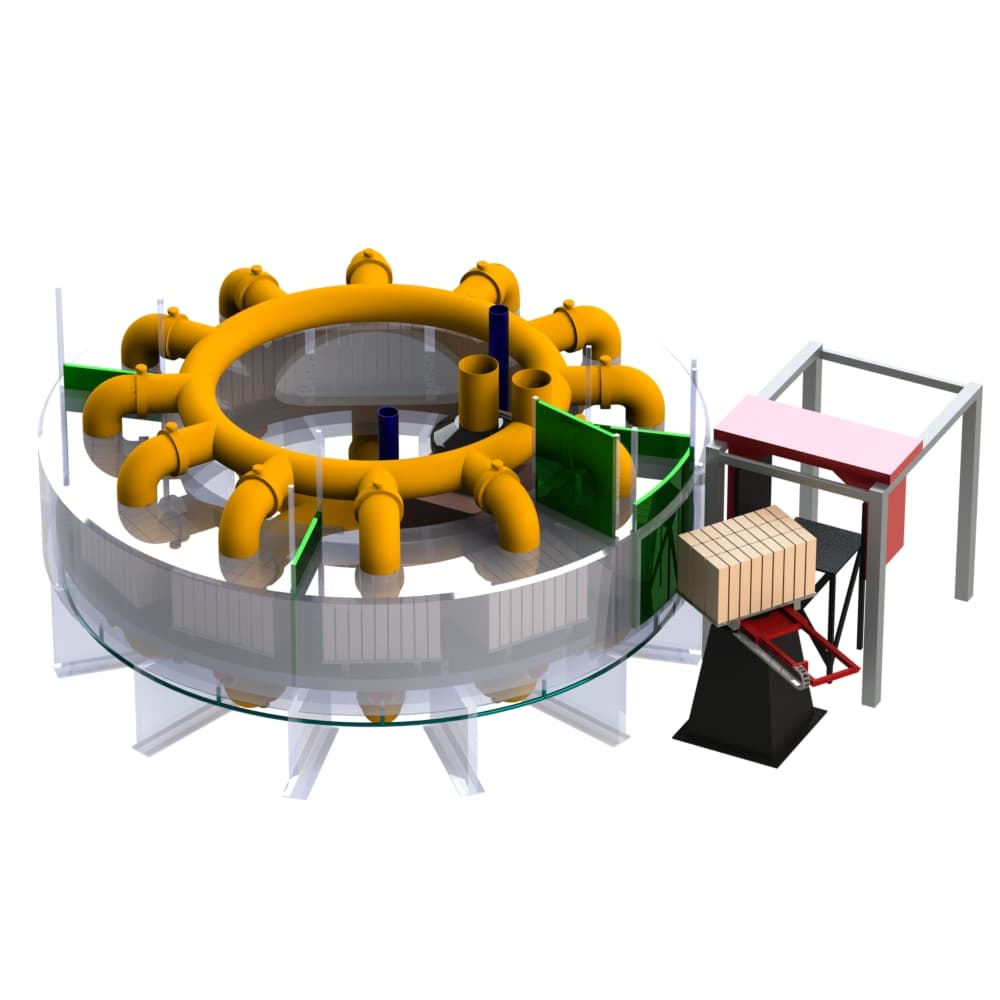
1 imageConcept design — chamber + automated stacking, CO₂ from co-located emission source.
The Challenge
Carbonate-binder brick is a building-material chemistry that uses CO₂ as part of its cure. Inside a chamber, calcium hydroxide in the green body reacts with CO₂ to form calcium carbonate — the binder that gives the brick its strength. Doing this at industrial scale needs three engineering pieces designed together: a chamber that delivers CO₂ uniformly across a charge, an automated stacking and transport system so the chamber operates as part of a line, and a CO₂ source that's economically defensible.
Why this is a process engineering problem, not just a chamber
- *CO₂ delivery to the green body.* The cure reaction has to reach the inside of each brick, not just its surface. Chamber geometry, gas flow, and dwell time decide whether the cure is uniform or only skin-deep.
- *CO₂ source economics.* Capturing CO₂ specifically for this process would dominate the per-brick cost. The economic answer is to use *waste* CO₂ — emissions from boiler houses, thermal power plants, or other industrial sources that already produce CO₂ as a by-product.
- *Automated stacking.* The chamber is a stage in a line; charging and discharging have to happen without per-cycle operator work.
Why the emission-source coupling matters
Cement-bound bricks are cured under heat and humidity — energy in, no chemistry input. Carbonate-binder bricks cure under CO₂ — emission in, chemistry output. The economics flip when the CO₂ comes from a co-located emission source: the brick plant becomes a carbon sink for the boiler house, not just a building-material producer.
Our Approach
We developed the conceptual design for the chamber and its integrated stacking-and-transport system, on the assumption that CO₂ comes from co-located industrial emissions — boiler-house flue, thermal plant exhaust, or comparable industrial source — rather than a purpose-built CO₂ supply.
Chamber design inputs
- *CO₂ atmosphere.* Chamber holds the green body in a CO₂-rich atmosphere through the cure dwell.
- *Uniformity.* Internal flow geometry sized for uniform CO₂ contact across the load.
- *Dwell.* Cycle time set against the chemistry — calcium hydroxide → calcium carbonate has known reaction kinetics that set the cure dwell.
- *Automated stacking.* The chamber accepts a pre-stacked charge and discharges a cured charge without operator intervention per cycle.
CO₂ source integration
The chamber is designed to use CO₂ from emission sources — boiler houses, thermal power plants, industrial facilities — meaning the CO₂ supply line interfaces with the upstream emission source rather than an industrial-gas vendor. This is the design decision that makes the technology *economically* viable, not just chemically viable.
Concept-design scope
The deliverable is a conceptual design — chamber geometry, automated stacking and transport architecture, CO₂ source integration approach. Production engineering (full mechanical, electrical, controls) follows on engagement extension.
Results
The concept design covers the chamber, the integrated stacking and transport system, and the architecture for CO₂ sourcing from co-located industrial emissions. It establishes the technology basis for a brick-production line whose cure medium is captured CO₂ — converting an emission stream into a binder reaction.
What the concept demonstrates
- *Carbonate-binder chemistry as a production technology.* Calcium hydroxide → calcium carbonate inside the chamber, at scale.
- *Emission-source coupling.* Industrial CO₂ as feedstock, not bought CO₂.
- *Automated line stage.* The chamber is designed as a line stage with automated charge/discharge, not a standalone laboratory cure box.
- *Economic geometry.* CO₂ supply economics handled by emission-source coupling, not by purchasing CO₂ at industrial-gas prices.
Where this fits in the larger building-materials roadmap
Conventional cement-bound brick uses heat + humidity to cure. The cement chemistry is well-understood and the energy economics are favorable. Carbonate-binder brick is a different chemistry — and the engineering question is whether the production economics work.
This concept design answers "yes, *if* you couple the chamber to an emission source." That coupling is the load-bearing economic insight: the brick plant pays the chamber's capital cost, and the boiler house pays for the brick plant's CO₂ supply by having less stack emission. Both parties win.
The concept is the engineering starting point for a production line built on that economic model.
Browse the portfolio
Filter by industry or service.
Next case studyAutomatic Fly Feeder — Experimental Stage for a Waste-Processing Investment
IoT & Embedded
Related Engagements
- Industrial & Manufacturing
Press Molds for Semi-Dry Pressing — Facing-Product Family at 300 kg/cm²
Read - Industrial & Manufacturing
Heat & Humidity Curing Chamber — 8-Hour Strength Cycle with Heat Recovery
Read - Industrial & Manufacturing
Mechanical Engineering Workshop — 600 m² Tooling Production Build-Out
Read