Mechanical engineering · Process equipment
Revolver Press for Hyper-Pressed Brick — 4× Throughput Over Single-Stage
Client
Confidential — Building Materials
Duration
16 weeks
Year
2023
Designed a four-station indexed revolver press for hyper-pressed brick that more than quadruples throughput over conventional single-stage presses, by overlapping the pressing cycle across four indexed stations on a turret. Same dwell, same quality, four bricks per cycle instead of one.
Engagement Metrics
4
Pressing stations
≥ 4×
Throughput vs single-stage
Indexed turret
Cycle architecture
P3200 / P4800
Tonnage class
From the project
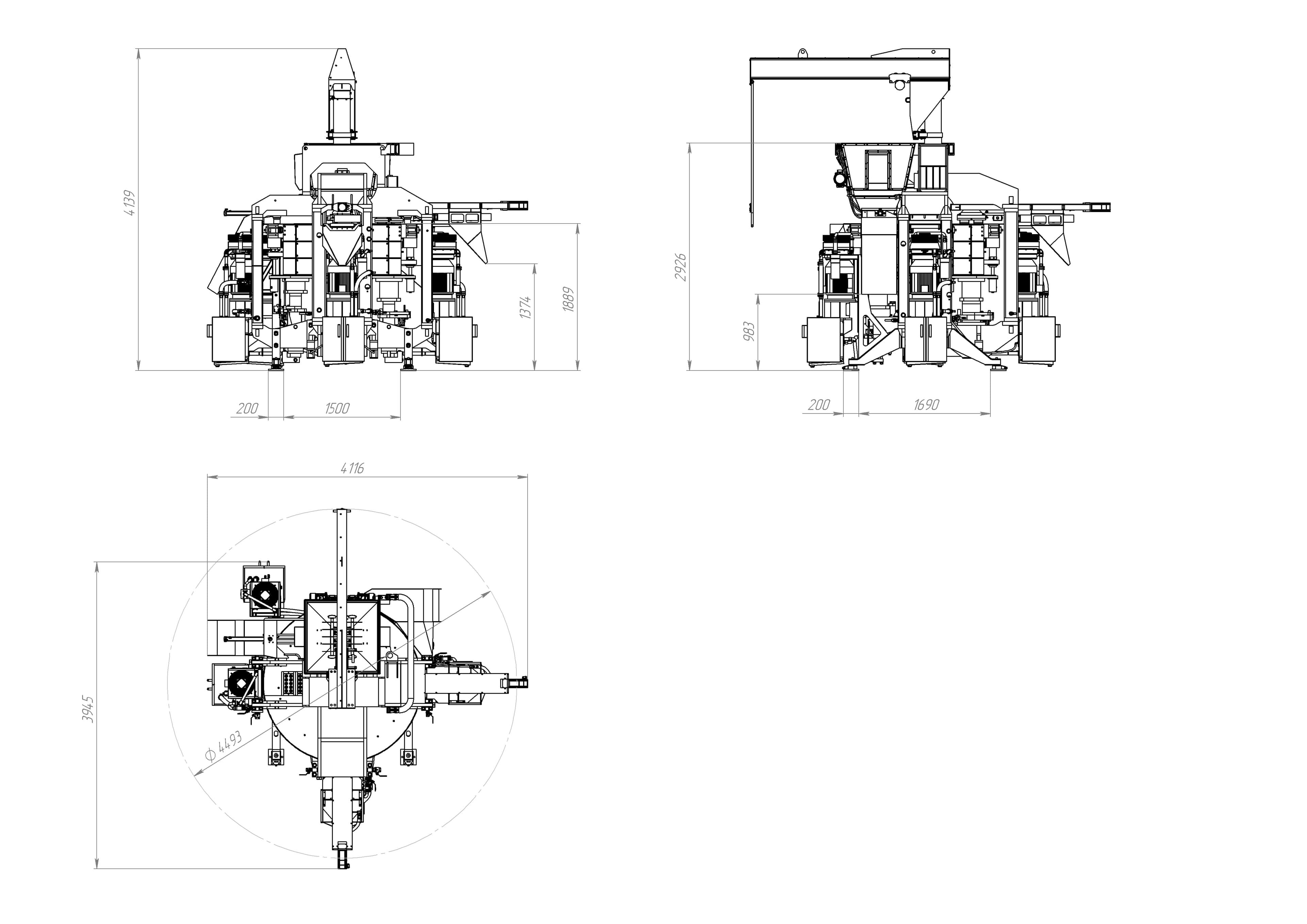
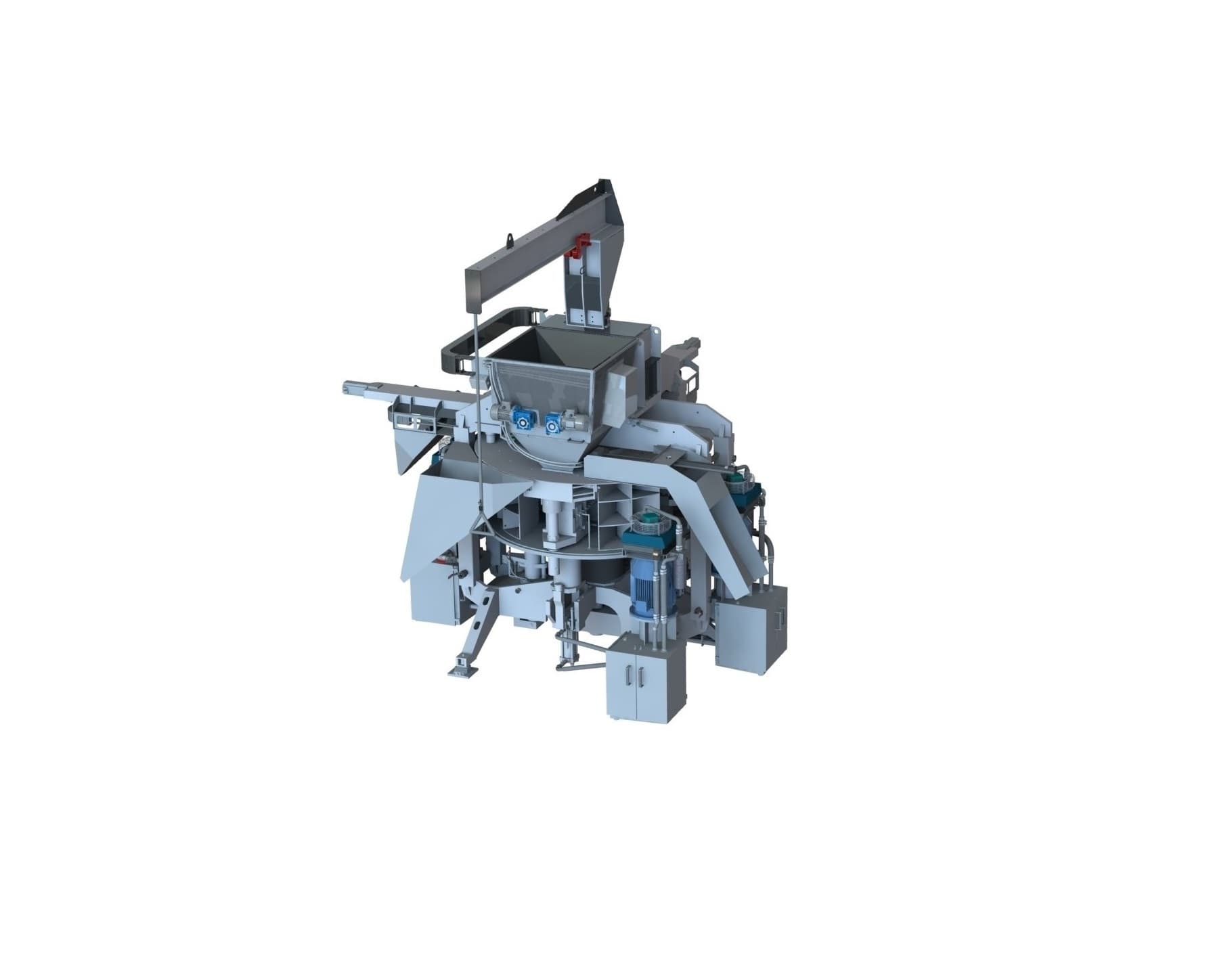
2 imagesP3200 — smaller-tonnage variant, same four-station architecture. P4800 production assembly — full press with frame, hydraulics, and turret.
The Challenge
Hyper-pressed brick requires high specific pressure held for a defined dwell. On a single-station press, dwell time dominates the cycle — the press is idle waiting on the green body. Throughput is capped by that dwell regardless of how fast the kinematics move.
Where conventional throughput hits a wall
The physics of hyper-pressing don't admit a shortcut. Reducing dwell time means reducing brick quality — uneven density, edge spalling, dimensional inconsistency. A faster ram doesn't help: the brick is finished pressing in milliseconds, but the dwell that *sets* the green body is the slow step.
Producers wanting more throughput from a single-stage architecture had two unappealing options: cut dwell (and quality), or buy another whole press.
Our Approach
We split the cycle across four pressing stations on an indexed turret. While one station holds dwell, the next stations run dosing, pre-press, full-press, and ejection operations in parallel. The press hydraulics, frame, and tooling were designed around the turret indexing geometry so that station alignment under load stays within the dimensional tolerance of the green body.
How the four-station cycle decomposes
- *Station 1 — Dosing.* Raw mixture fills the die cavity to the correct fill height.
- *Station 2 — Pre-press.* Initial compaction sets the green body geometry.
- *Station 3 — Full press + dwell.* Specific pressure holds for the full dwell time required by the cement binder.
- *Station 4 — Ejection.* The completed green brick is removed and transported off the press for curing.
The four stations run simultaneously. Cycle time at the press level is no longer dwell-limited at the brick level; it's index-limited at the turret level. As long as the turret can index between dwells, brick output is four per cycle.
What the design had to prove
- Turret-indexing accuracy under load — within the dimensional tolerance of the green body.
- Hydraulic synchronization across four stations sharing a frame.
- Frame deflection budget that holds across all four pressing positions.
- Tooling alignment that survives indexing — repeatable, not asymptotic.
The full assembly was modeled in 3D with kinematic constraints simulated. Tonnage, deflection under load, and turret indexing accuracy were verified against the design budget before the first part was cut.
Results
Each station still gives the brick its full dwell — quality is unchanged from a single-stage press of the same tonnage class. But the press itself is producing four bricks per cycle. Effective throughput exceeds 4× the single-stage analogue once parallelism and shorter station-specific cycle times are factored in.
What this changes economically
A single revolver press replaces four single-stage presses' worth of capacity. That's one frame, one hydraulics stack, one electrical cabinet, one maintenance schedule — instead of four. Footprint drops correspondingly. Operator headcount drops correspondingly. And the per-brick cost — capital amortization plus operations — drops more than 4× because frame, hydraulics, and cabinet are amortized once, not four times.
Two tonnage classes — P3200 and P4800
The revolver architecture scales by tonnage class. We delivered two designs:
- *P3200* — lower-tonnage variant, four stations, smaller frame mass. Targets producers whose brick spec needs the dwell but not the maximum specific pressure.
- *P4800* — production-class press with the full frame, hydraulics, and turret sized for the heavier brick spec.
Both share the same four-station logic and the same operator workflow. The difference is frame mass and hydraulic capacity, not control architecture or maintenance regime.
Engineering verification before manufacturing
Before any frame steel was cut, the design ran against four verification gates:
- *Static load.* Frame deflection under maximum tonnage at every turret position — within the per-brick dimensional budget.
- *Hydraulic sync.* Four-station synchronization without cross-talk — each station hits its specific pressure target independently.
- *Index accuracy.* Turret indexing repeatability under cycling load — the brick lands in the same spot every cycle.
- *Tooling life.* Die clearance and material selection for the cement-binder abrasion profile — sustained production, not a hundred-cycle demo.
Browse the portfolio
Filter by industry or service.
Next case studySemi-Dry Press for Facing Bricks & Tiles — 900 Bricks per Hour
Industrial & Manufacturing
Related Engagements
- Industrial & Manufacturing
Press Molds for Semi-Dry Pressing — Facing-Product Family at 300 kg/cm²
Read - Industrial & Manufacturing
Heat & Humidity Curing Chamber — 8-Hour Strength Cycle with Heat Recovery
Read - Industrial & Manufacturing
Mechanical Engineering Workshop — 600 m² Tooling Production Build-Out
Read