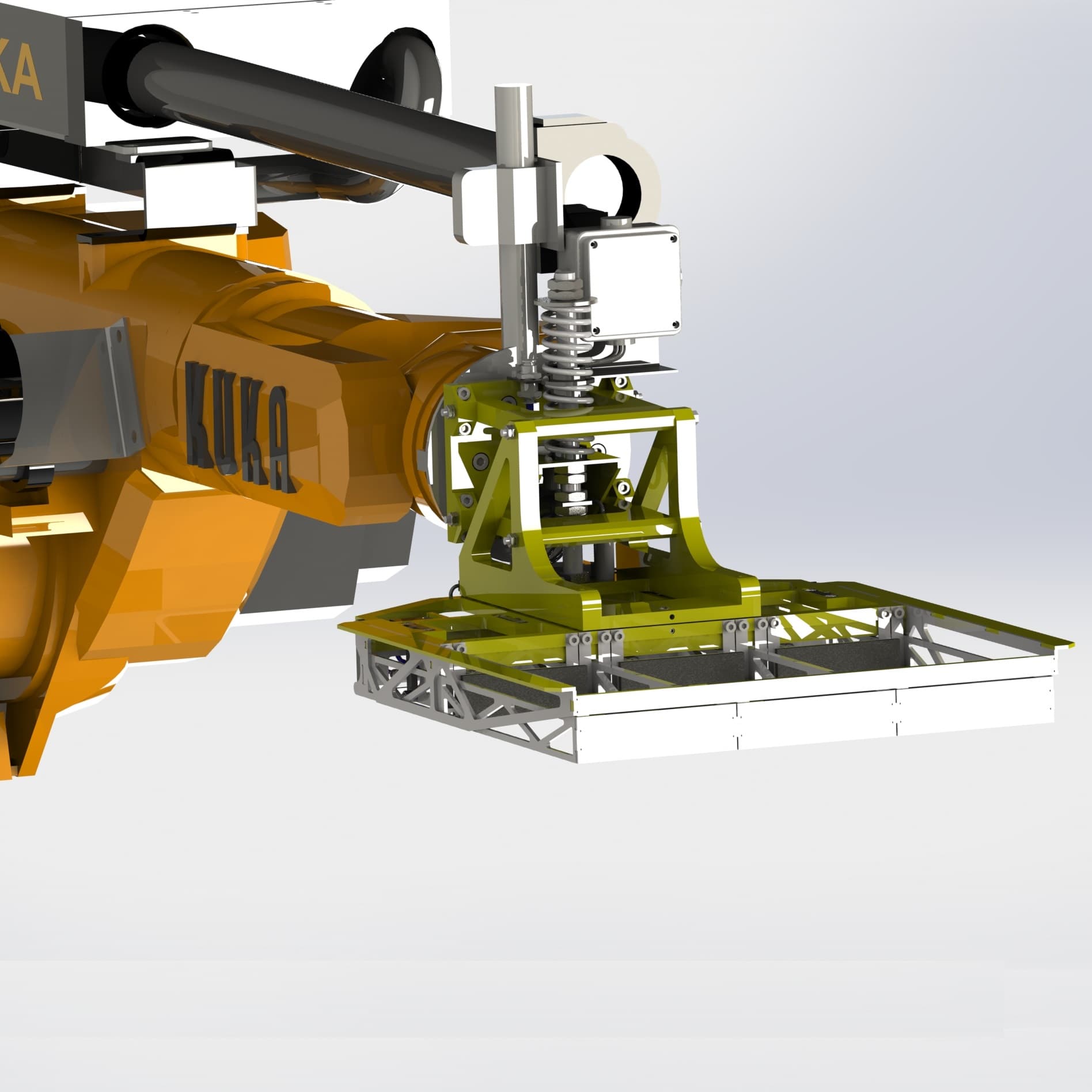
Robotic end-effector · KUKA-adapted · Press tooling
KUKA-Adapted Gripper — 1–9 Products per Cycle, 15 kg Capacity
Client
Confidential — Building Materials
Duration
10 weeks
Year
2019
A gripper end-effector adapted to KUKA robotic manipulators for removing pressed product from a semi-dry pressing machine and arranging it in stacking patterns per a preset program. Handles 1 to 9 products per cycle at 15 kg total load capacity.
Engagement Metrics
1 – 9
Products per cycle
15 kg
Load capacity
KUKA manipulators
Adaptor
Press exit → stacking
Function
From the project
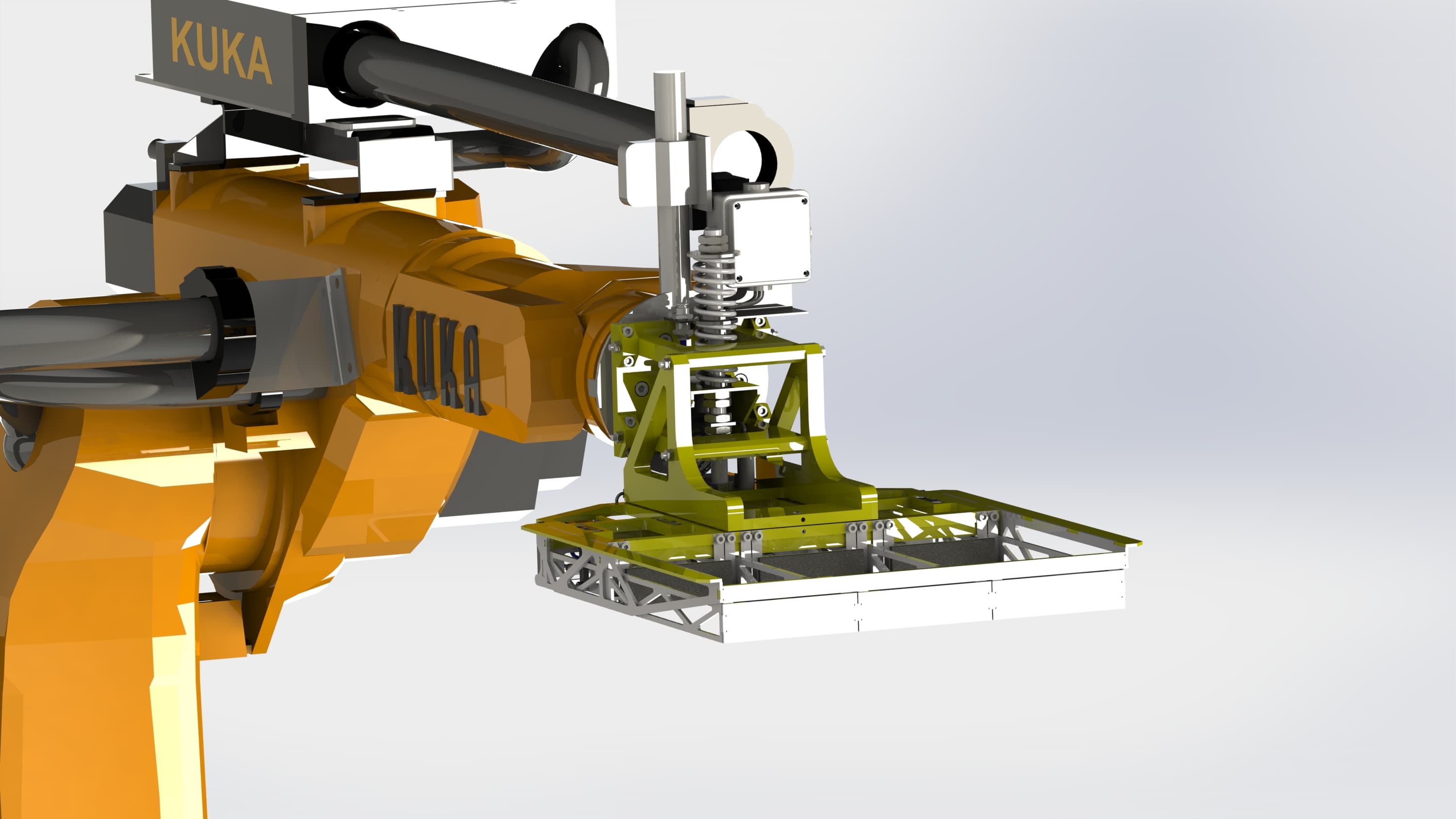
2 imagesEngaged — multi-product cycle on KUKA manipulator. Mid-cycle — KUKA tool flange interface, 15 kg total load.
The Challenge
KUKA manipulators are widely used in industrial automation — but a manipulator without the right end-effector is a robot waiting for a job. For cladding-product lines, the end-effector has to handle 1 to 9 products per cycle (the press's output count varies by product geometry), survive cement-binder dust, and integrate cleanly with the KUKA's tool flange without forcing custom robot-side modifications.
What "adapted to KUKA" actually means
- *Mounting interface.* The gripper mounts on the KUKA tool flange — no robot-side modification needed.
- *Communications profile.* End-effector control follows KUKA's expected interface so the cell controller doesn't need bespoke wiring.
- *Payload within rated envelope.* 15 kg total — sized to the robots typically deployed on this kind of cell.
Why product count per cycle varies
The press output count depends on geometry and tooling. A standard brick press might output 5 per cycle; a smaller-product press might output 9. The end-effector has to handle the full range from 1 product to 9 products per cycle without geometry-specific re-tooling between runs.
Our Approach
We designed the end-effector against the KUKA mounting and communication profile, with a gripping geometry that accommodates 1 to 9 products per cycle at a constant total load capacity of 15 kg.
Engineering inputs
- *KUKA tool flange interface.* Standard mounting — no robot-side custom work.
- *Gripper geometry.* Accommodates the press's output count range (1 to 9 products) without re-tooling for product changes.
- *Cycle behavior.* Pick-place-release cycle matched to the KUKA's typical motion envelope.
- *Stacking-program follower.* Stacking patterns set by preset program at the cell controller — the gripper executes; the controller decides.
Why standardize the mount
A captive end-effector locks the cell into a specific gripper. A KUKA-standard mount means the same robot can be re-tooled to other end-effectors when needed (maintenance, product change, repurposing) without engineering work on the robot itself.
Results
The end-effector is in service on KUKA manipulators handling cladding output at the press exit. 1 to 9 products per cycle, 15 kg total load, mounted on the KUKA tool flange without robot-side modification.
Operational behavior
- *Variable cycle output.* Same end-effector handles single-product and multi-product output without re-tooling.
- *Stacking-program flexibility.* Pattern is set by the cell controller; the end-effector follows.
- *KUKA-portable.* The same gripper design can move between KUKA robots in a multi-cell facility.
Why the variable product count matters
Most grippers handle a fixed product count per cycle. That's fine when the press's output is fixed. The moment the line introduces a product variant with a different press-output count, a fixed-count gripper has to be re-engineered or replaced.
Designing for the 1-to-9 range up front means the line can introduce new product geometries — within that count range — without going back to the gripper designer. That's the difference between a gripper tied to one product and a gripper tied to the customer's *line*.
Browse the portfolio
Filter by industry or service.
Next case studyStandard Gripper — Magnetic-Mount End-Effector for Press Exits
Industrial & Manufacturing
Related Engagements
- Industrial & Manufacturing
Press Molds for Semi-Dry Pressing — Facing-Product Family at 300 kg/cm²
Read - Industrial & Manufacturing
Heat & Humidity Curing Chamber — 8-Hour Strength Cycle with Heat Recovery
Read - Industrial & Manufacturing
Mechanical Engineering Workshop — 600 m² Tooling Production Build-Out
Read