Automation · Robotic handling · Semi-dry pressing
Gripper Manipulator — Automated Cladding-Brick Line at 25 Bricks/Minute
Client
Confidential — Building Materials
Duration
12 weeks
Year
2016
A gripper-equipped manipulator designed for an automated cladding-product line on semi-dry pressing. Removes pressed product from the press exit and places it in cage according to a preset stacking program — 25 standard bricks per minute, 6 kW installed electrical capacity.
Engagement Metrics
25 bricks/min
Throughput
6 kW
Installed electrical
Press exit → stacking
Function
Cladding · Semi-dry
Process
From the project
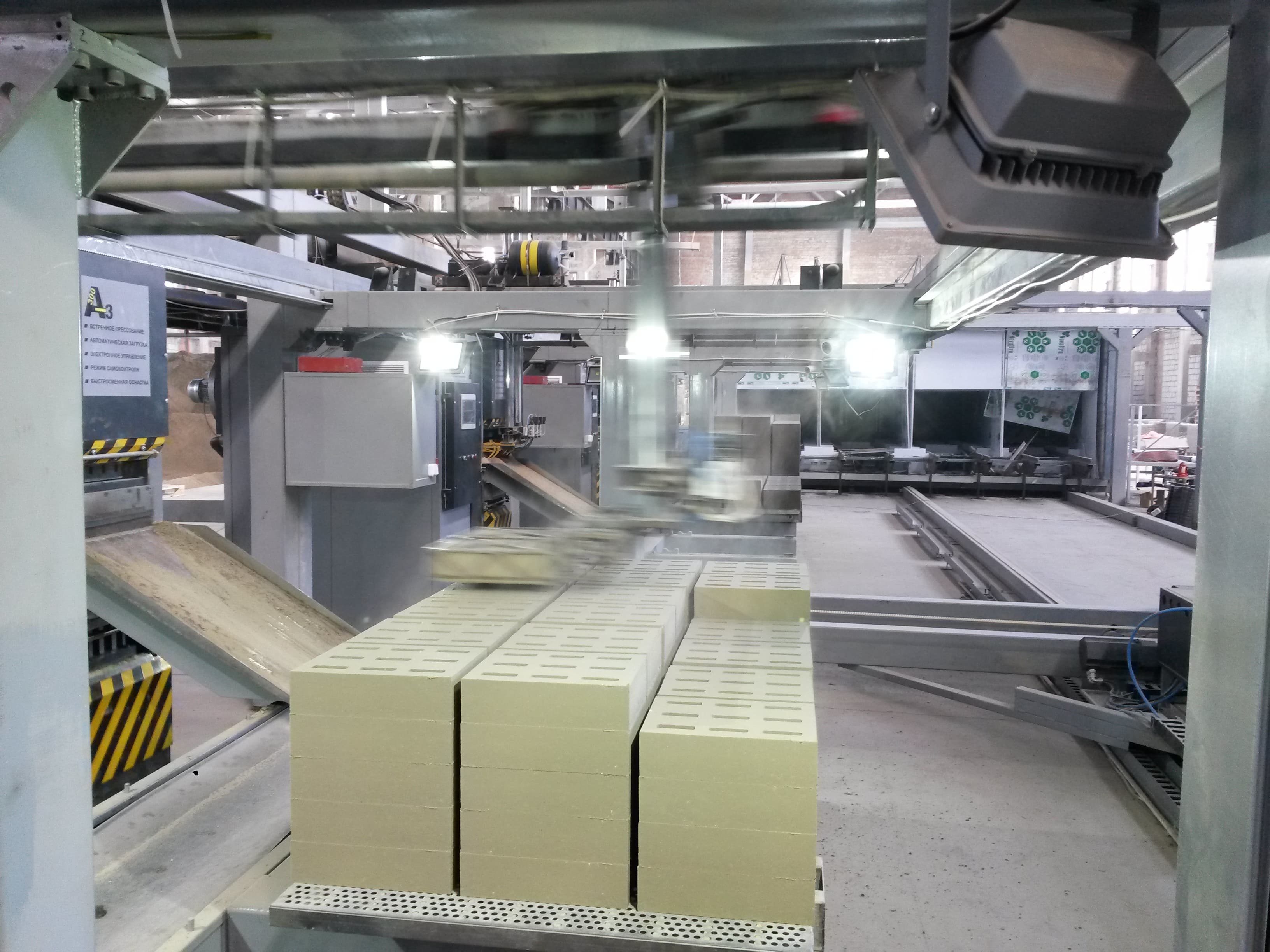
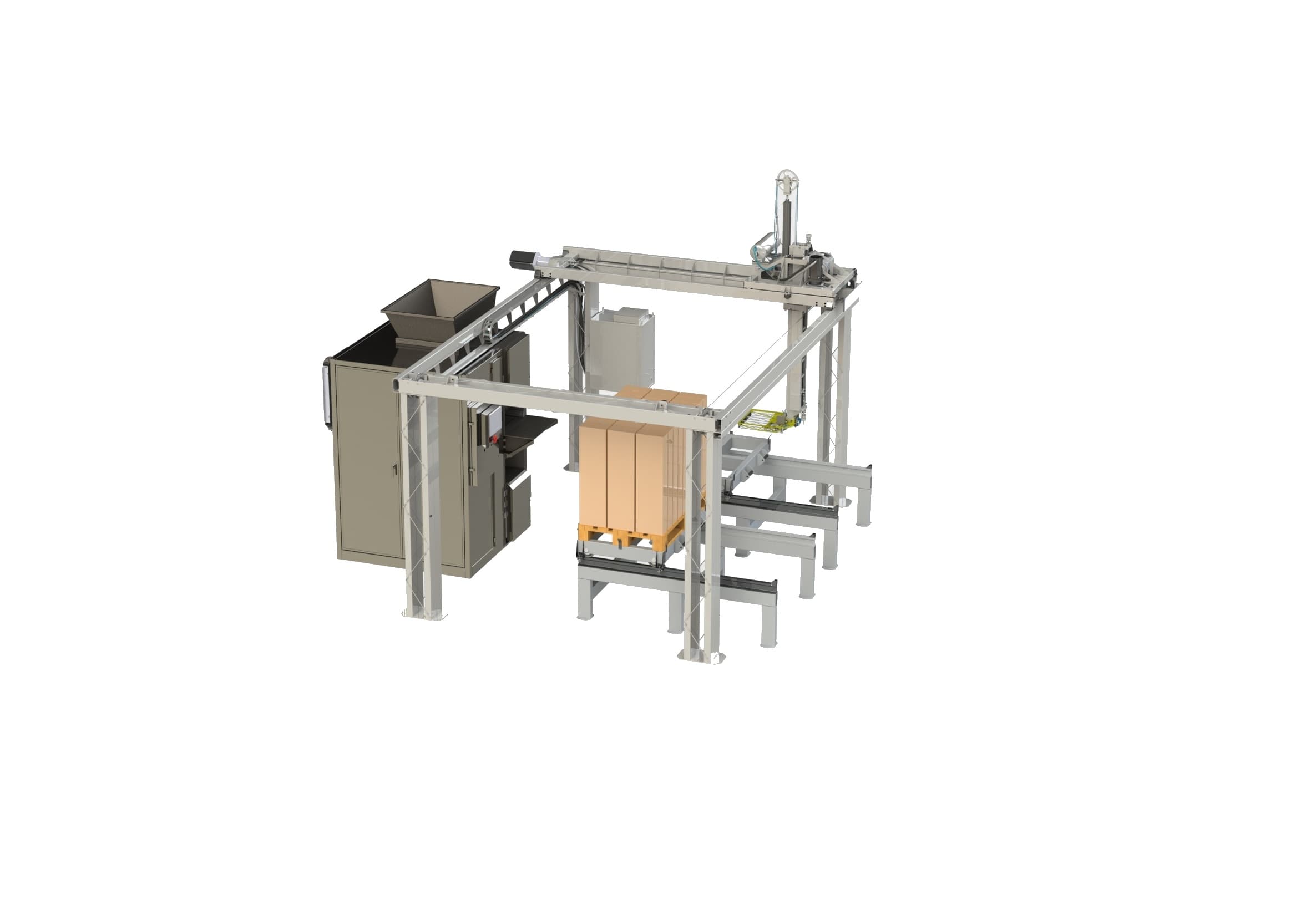
2 imagesInstalled at the press exit — 25 bricks/minute against press cadence. CAD reference — manipulator integrated with the A300 press.
The Challenge
The press cycles faster than a human stacker can keep up with at production rates. Without automated handling at the press exit, the line's effective throughput is whatever the slowest operator at the cage can do — not what the press can produce. The brief was to replace that bottleneck with a manipulator capable of holding the press's natural cadence.
What the manipulator has to handle
- *Removal from the press without scuffing.* The green body leaves the press just-formed — surface finish has to survive the handling cycle into the cage.
- *Stacking-program flexibility.* Different downstream packaging requires different stacking patterns. The manipulator follows a preset program; it isn't a one-pattern-only mechanism.
- *Cadence matching.* 25 bricks per minute is the press's natural production cadence on this product class — the manipulator can't be the bottleneck.
- *6 kW envelope.* The installed electrical capacity sets the motion budget. Drive selection and trajectory planning live within it.
Our Approach
We designed the manipulator end-to-end: the gripper geometry that handles cladding green bodies without surface damage, the kinematic envelope to reach press exit and cage placement at 25 bricks/minute, and the drive sizing to run that motion inside a 6 kW installed-electrical envelope.
Engineering inputs
- *Gripper geometry.* Sized to cladding-product dimensions, surfaces tuned for green-body finish preservation.
- *Stacking-program follower.* The manipulator runs a preset stacking program — pattern is configurable per downstream cage layout.
- *Cadence target.* 25 bricks/minute matches the press's natural cycle rate on this product class.
- *Electrical envelope.* 6 kW installed electrical capacity — drive selection, deceleration profiles, and dwell management all sized to that budget.
Why preset programs, not on-the-fly planning
The stacking patterns the cage accepts are known geometries — the right tool is a programmed sequence, not a perception + planning system. Programmed sequencing keeps the controller simple, the cycle time deterministic, and the production rate predictable.
Results
The manipulator runs at 25 bricks/minute on cladding-product output from the press, placing into cage per the preset stacking program. Installed electrical capacity stays inside the 6 kW envelope.
What the line looks like with the manipulator installed
- *Press cadence held.* The line operates at the press's natural cycle rate rather than at the operator's stacking rate.
- *Consistent stacking.* Cage layout matches the downstream packaging spec on every cycle.
- *Reduced labour.* The role at the press exit converts from per-cycle stacking to monitoring across multiple cycles.
- *Stable electrical draw.* 6 kW installed capacity — easy to budget at panel sizing.
Where this manipulator sits in the line
The manipulator lives at the press exit. Upstream: semi-dry pressing of cladding bodies on a cement binder. Downstream: cage palletization. Without it, the press's 25-bricks/minute cycle bottlenecks at the press-exit handoff — the rest of the line waits on a single hand-stacking station.
With the manipulator in place, the press dictates the cycle, the manipulator follows, and the downstream cage receives finished stacks ready for curing. It is one of the building blocks of the integrated brick line.
Browse the portfolio
Filter by industry or service.
Next case studyKUKA-Adapted Gripper — 1–9 Products per Cycle, 15 kg Capacity
Industrial & Manufacturing
Related Engagements
- Industrial & Manufacturing
Press Molds for Semi-Dry Pressing — Facing-Product Family at 300 kg/cm²
Read - Industrial & Manufacturing
Heat & Humidity Curing Chamber — 8-Hour Strength Cycle with Heat Recovery
Read - Industrial & Manufacturing
Mechanical Engineering Workshop — 600 m² Tooling Production Build-Out
Read