Industrial automation · Plant engineering · Sketch to commissioning
Automated Facing-Brick Line — 15M Bricks / Year on Semi-Dry Cement Pressing
Client
Confidential — Building Materials
Duration
Multi-year program · in production since 2015
Year
2015
Designed and commissioned the most-automated production line in its class for facing brick on semi-dry cement-bound pressing — 15 million conventional bricks per year on an 800m² footprint. Owned end-to-end from sketch through commissioning at the first customer site. Operating in production continuously since 2015.
Engagement Metrics
15M bricks/yr
Annual output
800 m²
Footprint
2015
In production since
Sketch → commissioning
Scope
From the project
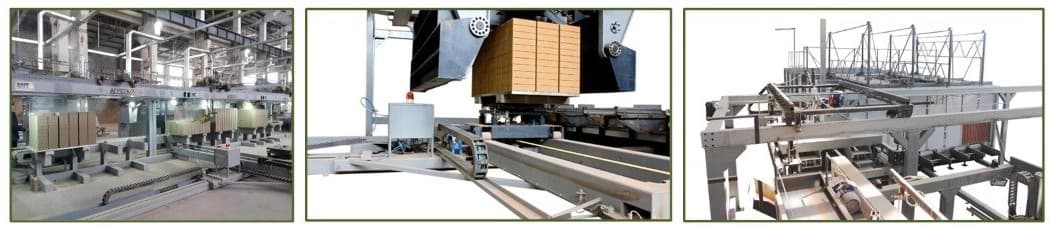
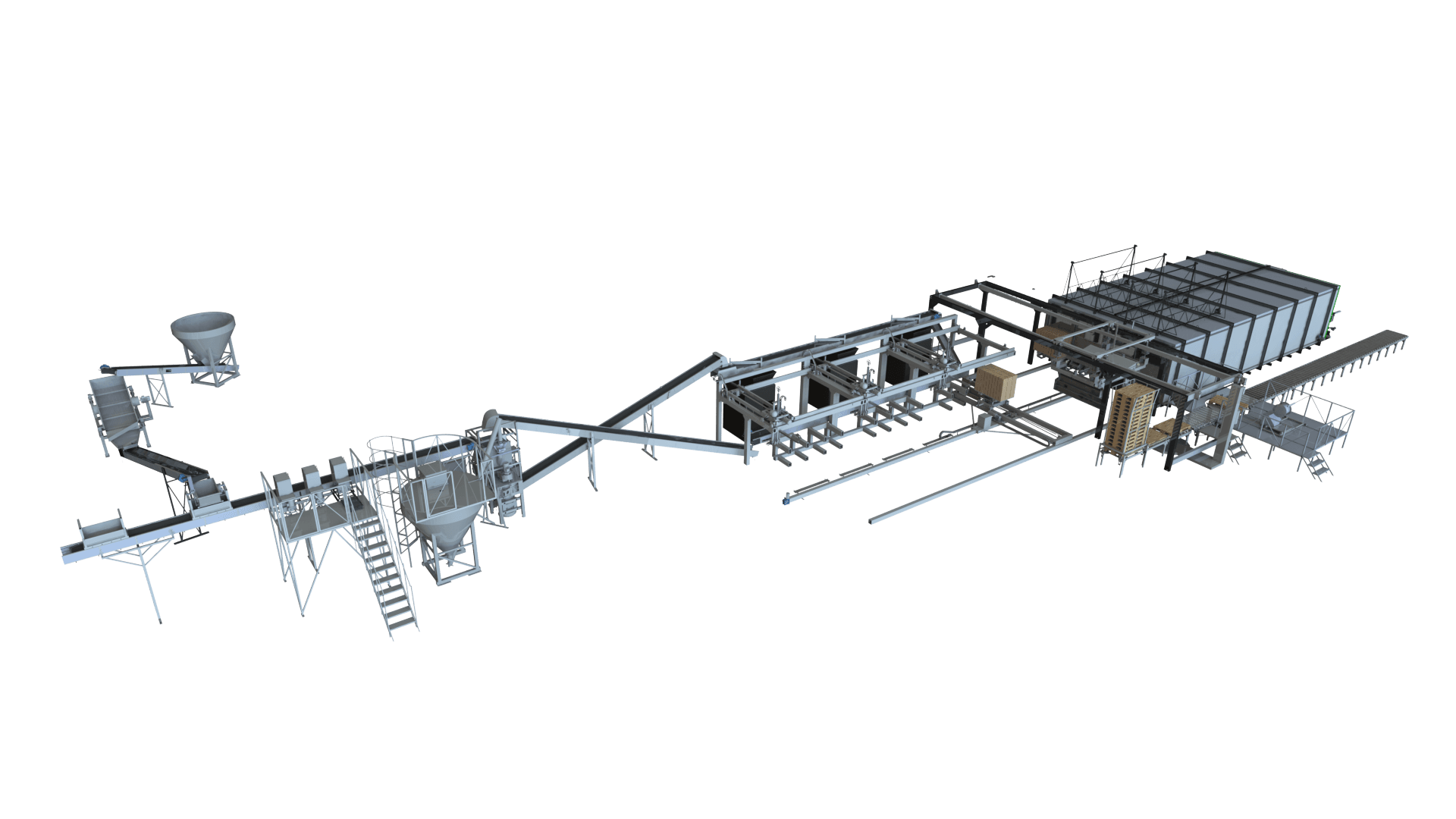
2 imagesInstalled and operating since 2015 — 15M conventional bricks/year on 800m². Plant layout — pressing, curing, and palletization integrated as one machine.
The Challenge
Facing-brick production on semi-dry cement binder has historically required either large labour-intensive plants or smaller plants with significant per-cycle downtime. The client wanted a single integrated line that hit a 15M-brick annual output at a footprint small enough for industrial sites that couldn't host a traditional plant.
What "most-automated in its class" had to mean
Automation isn't a marketing claim if the line still needs operators to move material between cells, restart equipment between cycles, or hand-feed any stage. The brief was specific: the line runs as one coordinated machine, operator presence is for monitoring and material logistics rather than per-cycle action, and footprint is small enough to install on industrial sites that can't host a traditional plant.
The 800m² constraint
A conventional plant of equivalent output sits on multiple thousands of square meters. Hitting 800m² required integrating function — pressing, curing, and palletization sharing space rather than each requiring its own bay. That's a plant-layout problem, an automation problem, and a process-engineering problem at the same time.
Our Approach
We owned the entire program: concept sketches, full mechanical and process design, electrical and control specification, layout, build, and commissioning at the first customer site. One organization, one engineering practice, one accountability path.
Integrated function — the line as one machine
The line integrates raw material handling, dosing, semi-dry pressing on a cement binder, curing, palletizing, and quality reject — running as one coordinated machine rather than separate cells. Automation runs the whole line; operator presence is for monitoring and material logistics rather than per-cycle action.
Stages, integrated end-to-end
- *Raw material handling.* Aggregate, cement, and pigment intake — automated dosing.
- *Pressing.* Semi-dry cement-bound pressing at production tonnage.
- *Curing.* In-line curing without a separate bay — the curing process shares the line's footprint with pressing and palletization.
- *Palletization.* Automated stacking and pallet-builder integration.
- *Quality reject.* In-line reject without operator inspection at every cycle.
Why the footprint works
The 800m² figure isn't achieved by compressing each stage; it's achieved by *integrating* them. Pressing, curing, and palletization share space rather than each requiring its own dedicated bay. That layout is the load-bearing engineering decision behind the plant economics.
Results
The line has run in production since 2015 at the first customer site. Annual output: 15 million conventional bricks. Footprint: 800m² — a fraction of a conventional plant of equivalent output. It remains the most-automated line in its class for this technology.
What's notable a decade in
- *Continuous production since 2015.* The control architecture, mechanical design, and process integration have held through a decade of production. No structural redesigns.
- *15M bricks per year — sustained.* The output figure is annual averaged, not a peak-hour extrapolation.
- *Single-site commissioning still standing.* The line was commissioned at the first customer site; the same site is still operating it.
Scope — what owning the program end-to-end actually meant
Engineering
- Concept sketches and feasibility
- Full mechanical design (3D CAD, drawings, BOM)
- Process engineering (mix design support, cycle architecture, curing integration)
- Electrical specification
- Control system specification
- Plant layout for the 800m² footprint constraint
Delivery
- Procurement and fabrication
- Assembly
- Site installation
- Commissioning at the first customer site
- Ongoing-production handover
No subcontracting of engineering accountability. The same practice that drew the line on day one was on site at commissioning.
Why this engagement is the reference
When prospective clients ask whether we've actually delivered a fully automated production line — not a cell, not a pilot, but a plant — this is the engagement we point to. It's been running continuously since 2015 at a single customer site, at the rated annual output, at the rated footprint.
It is also a good demonstration of the multi-disciplinary scope: mechanical engineering, process engineering, electrical, controls, layout, and site commissioning all in one practice.
Browse the portfolio
Filter by industry or service.
Next case studyGripper Manipulator — Automated Cladding-Brick Line at 25 Bricks/Minute
Industrial & Manufacturing
Related Engagements
- Industrial & Manufacturing
Press Molds for Semi-Dry Pressing — Facing-Product Family at 300 kg/cm²
Read - Industrial & Manufacturing
Heat & Humidity Curing Chamber — 8-Hour Strength Cycle with Heat Recovery
Read - Industrial & Manufacturing
Mechanical Engineering Workshop — 600 m² Tooling Production Build-Out
Read