Mechanical engineering · Custom hardware
Twin 3D Printer Build Volumes — 300mm and 600mm Platforms
Client
Confidential — Industrial R&D
Duration
10 weeks
Year
2024
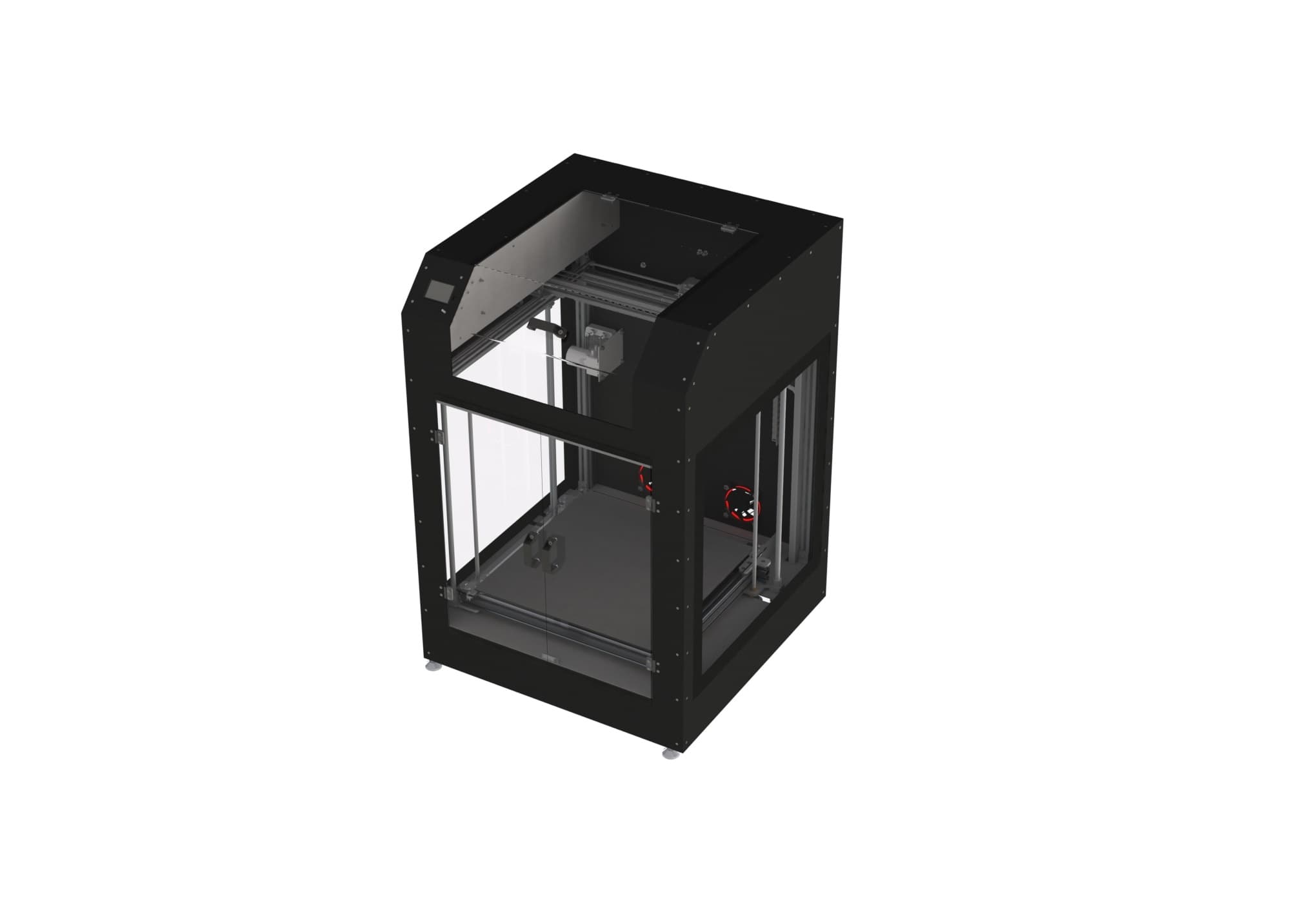
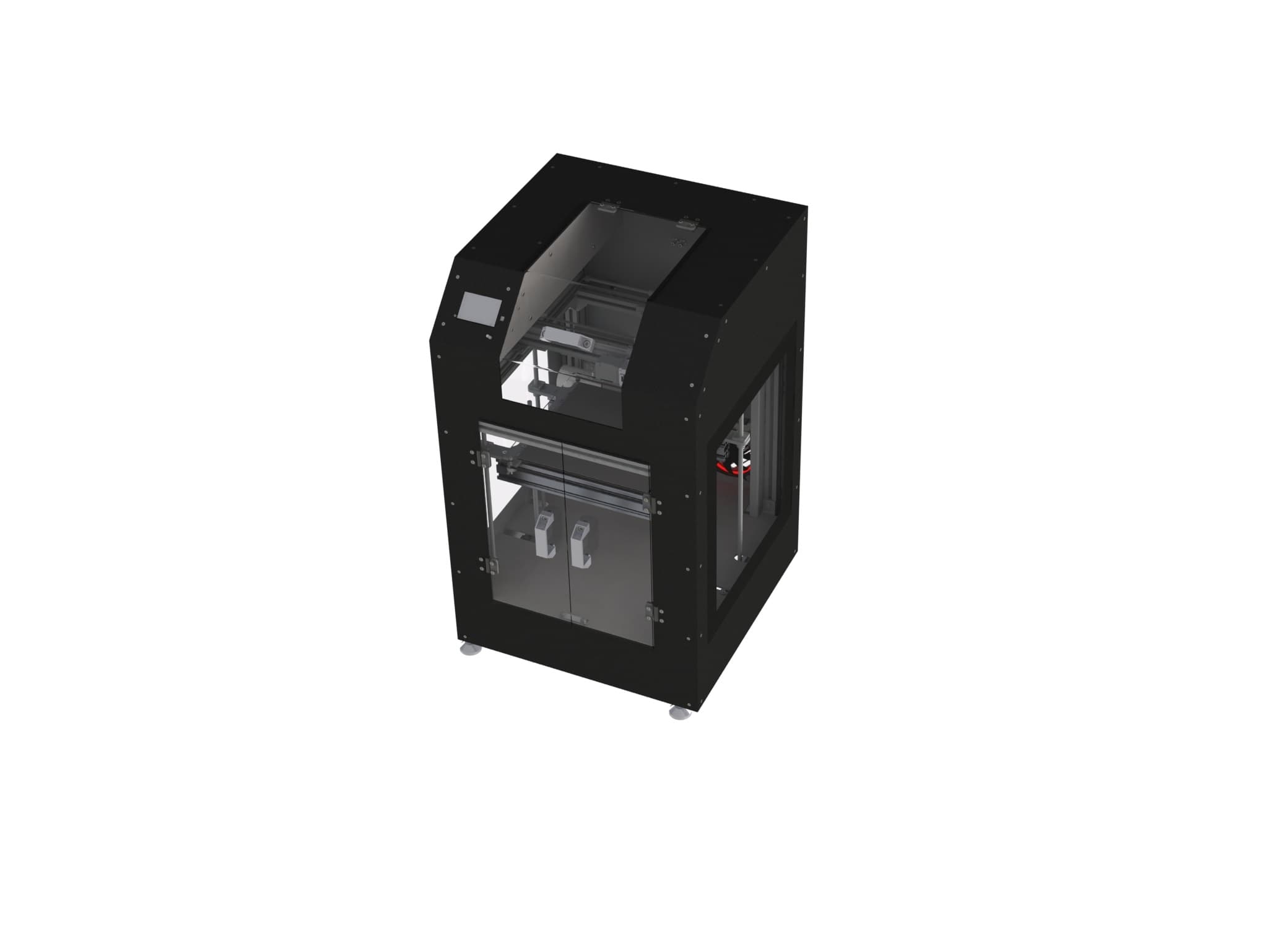
Designed two complete fused-filament 3D printers — a desktop platform at 300x300x300mm and a mid-format unit at 600x600x600mm — sharing a single kinematic class, electronics architecture, and firmware configuration so the client could field both SKUs with one parts catalog and one service workflow.
Engagement Metrics
300 / 600 mm
Build envelopes
70%+
Shared subsystems
CoreXY-class
Standard kinematics
2 production CAD packages
Total deliverable
From the project
2 imagesDesktop platform — 300×300×300mm build envelope, shared electronics. Mid-format platform — 600×600×600mm. Same controller, longer gantry.
The Challenge
The client needed two printers serving very different price points without doubling their engineering or BOM. A small desktop unit had to compete on cost and footprint against entry-tier consumer printers; a mid-format unit had to deliver a 27× larger build volume without sacrificing rigidity, thermal control, or print quality.
What "double the engineering" really costs
In practice, shipping two unrelated platforms means two PCBs, two firmware branches, two service-parts catalogs, two operator manuals, and two field-support workflows. For a small product team, that's the difference between launching one platform well and launching two platforms badly.
The brief was explicit: same controller, same hotend interface, same bed-leveling, same firmware build configuration — different envelope. Engineering effort per future variant had to stay bounded so a third or fourth size could ship without restarting the program.
Our Approach
We standardized on a single kinematic class and built two structural frames around it. The motion stack, controller, hotend interface, bed leveling, and firmware stayed common across both platforms; the differences live in the frame geometry, gantry length, and bed heater specification.
What stayed common across both SKUs
- Motion controller PCB and stepper drivers
- Hotend mount and toolhead geometry
- Bed leveling probe and procedure
- Firmware build (one configuration targets either machine)
- Fastener kit and harness routing conventions
- Operator interface and menu structure
What changed per SKU
- Frame extrusion lengths and corner brackets
- Gantry rail length and belt path
- Bed heater wattage and thermistor placement
- Power supply sizing
- Enclosure panel cut list
BOM, fasteners, and harnesses were intentionally shared so the client's purchasing and service teams could support both SKUs with one parts catalog. We delivered two production-ready CAD packages, a shared electronics architecture, and a single firmware build configuration that compiles for either machine.
Results
Both platforms now share more than 70% of their BOM at the line-item level. The 600mm unit prints parts that previously had to be split across multiple jobs on the smaller machine — a single-piece print on the mid-format unit replaces three glued sub-assemblies on the desktop unit. The 300mm unit reaches an entry-tier price the original product line couldn't hit.
Engineering time per future variant is now bounded. The next build envelope follows the same frame-only change: extrusion lengths, gantry length, bed heater spec, power supply. Everything above that — controller, firmware, toolhead, service workflow — carries forward unchanged.
Why a shared kinematic class matters
Most multi-size printer programs fail at the service layer, not at the engineering layer. Two unrelated PCBs means two spare-parts SKUs, two repair guides, two firmware update workflows. The cost compounds every quarter.
By standardizing on the same kinematics, the same motion electronics, and the same firmware configuration across both platforms, the service operation runs as one practice. A field engineer trained on the 300mm unit can diagnose the 600mm unit without retraining.
Adding a third platform
The design is set up to ship additional build envelopes with frame-only changes:
- Choose target X/Y/Z build dimensions.
- Specify extrusion lengths, gantry rail length, bed heater wattage, and power supply.
- Compile the existing firmware against the new machine profile.
- Run the existing bed leveling procedure.
A third platform — typically a 450mm-class unit between the two existing SKUs — is engineering-light: weeks rather than months, and ships into the same purchasing and service catalog.